


Page 34 - ISC PROCEEDINGS 21.4
P. 34
has contributed to maintaining income growth and access to social services. However,
                  from 2023 to 2025, the HDI has shown signs of stagnation, reflecting that digital growth
                  has not been strong enough to create a breakthrough in quality of life. A gap still exists
                  between digital transformation and the quality of human capital. This suggests that while
                  the digital economy has made positive contributions, it has not yet generated a significant
                  breakthrough in human development.
                        The proportion of digitally skilled workers was 24.1% in 2020, increasing to 28.3% in
                  2024, and is forecast to reach 29.2% in 2025. These figures indicate that the improvement
                  in digital skills remains slow and has not yet reached 30%. This reflects a shortage of high-
                  quality human resources for digital transformation in Vietnam, as the digital economy is
                  developing faster than the labor market’s absorptive capacity. From a sustainable
                  development perspective, if digital skills do not keep pace with the rate of digitalization, it
                  may lead to labor polarization, income inequality, and risks of social exclusion.
                        Internet payment transactions are an important indicator of digital transformation
                  in the economy. In Vietnam, the value reached 22,200,000 billion VND in 2020, declined
                  to 11,264,690 billion VND in 2021 due to the impact of the pandemic, and then increased
                  continuously from 2022 to 2025, reaching 24,745,862 billion VND. This trend shows
                  growing trust in electronic payments, strengthened digital financial infrastructure, and
                  deeper penetration of the digital economy into economic life. However, the fluctuation in
                  2021 indicates that the digital ecosystem remains sensitive to external shocks.
                        The proportion of the population with access to digital financial services is a key
                  determinant of sustainability. In Vietnam, about 68.44% of the adult population had
                  access to digital finance in 2020, slightly decreasing to 66% in 2021, then gradually rising
                  to 77% in 2024, and forecast to reach 87% in 2025—approaching universal digital financial
                  inclusion. This expansion helps reduce inequality in access to financial services, improve
                  SMEs’ and household businesses’ access to credit, and promote a cashless economy.
                  However, a digital divide between urban and rural areas remains, along with
                  cybersecurity and data privacy risks
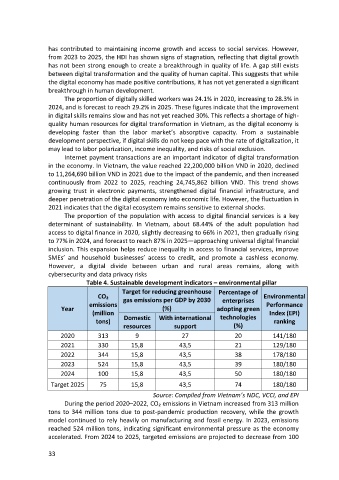
                               Table 4. Sustainable development indicators – environmental pillar
                                            Target for reducing greenhouse    Percentage of
                                   CO₂      gas emissions per GDP by 2030      enterprises    Environmental
                                emissions                                                      Performance
                       Year                               (%)                adopting green
                                 (million                                                       Index (EPI)
                                   tons)     Domestic    With international   technologies       ranking
                                            resources         support              (%)
                      2020         313           9               27                20            141/180

                      2021         330         15,8             43,5               21            129/180
                      2022         344         15,8             43,5               38            178/180
                      2023         524         15,8             43,5               39            180/180
                      2024         100         15,8             43,5               50            180/180
                   Target 2025      75         15,8             43,5               74            180/180

                                                       Source: Compiled from Vietnam’s NDC, VCCI, and EPI
                        During the period 2020–2022, CO₂ emissions in Vietnam increased from 313 million
                  tons to 344 million tons due to post-pandemic production recovery, while the growth
                  model continued to rely heavily on manufacturing and fossil energy. In 2023, emissions
                  reached 524 million tons, indicating significant environmental pressure as the economy
                  accelerated. From 2024 to 2025, targeted emissions are projected to decrease from 100

                  33

