


Page 32 - ISC PROCEEDINGS 21.4
P. 32
Regarding the growth of the ICT sector, which is the core driver of the digital
                  economy, statistics show that ICT revenue reached 120 billion USD in 2020 and increased
                  to 165.9 billion USD in 2024, representing nearly 65% growth over four years. The
                  forecast for 2025 is 198 billion USD. This strong growth reflects the expansion of
                  technology enterprises, increased production, and the export of software and digital
                  services. It contributes to the creation of high-quality jobs, promotes innovation, and
                  generates higher added value compared to resource-extractive industries. Moreover, the
                  ICT sector generally has lower emission intensity than many traditional industries, thereby
                  supporting a greener structural transformation in the long term.
                        In terms of digital infrastructure and Internet access, the proportion of the
                  population using the Internet increased from 70% in 2020 to 79.1% in 2024, with
                  particularly strong growth during 2022–2023 (from 73.1% to 79.1%). In 2025, the rate is
                  forecast to remain relatively stable at nearly 79%, indicating that Vietnam is approaching
                  Internet saturation (around 80%). This provides a fundamental foundation for e-
                  commerce, digital services, digital government, and digital finance. From a sustainable
                  development perspective, the Internet helps narrow the digital divide, enhance access to
                  public services, and improve transparency and governance.
                        The Digital Transformation Index (DTI) increased from 30.26% in 2020 to 79.55% in
                  2024—an approximately 2.6-fold rise within four years. This is the fastest improvement
                  among Vietnam’s digital economy indicators. It demonstrates the Government’s strong
                  push for digital transformation and the improved digital capacity of enterprises and local
                  authorities. However, the DTI has grown faster than the digital economy’s share of GDP,
                  suggesting that while digital transformation is progressing rapidly, its actual contribution
                  to GDP has not yet fully materialized.
                        E-commerce is the fastest-growing sector. E-commerce revenue rose from 11.8
                  billion USD in 2020 to 25 billion USD in 2024, and is forecast to reach 52 billion USD in
                  2025. If the 2025 forecast is achieved, revenue will have quadrupled within five years.
                  Thus, e-commerce is the strongest growth driver among all indicators. It significantly
                  contributes to sustainable development by improving distribution efficiency, reducing
                  intermediary costs, supporting SMEs in accessing markets, and promoting digital finance
                  and electronic payments. However, rapid e-commerce growth also increases packaging
                  waste, logistics activities, and transportation emissions. This highlights the need for green
                  e-commerce policies to ensure environmental sustainability, in line with SDGs 12 and 13
                        Considering the three pillars of the SDGs—economic, social, and environmental—
                  the current digital economy indicators are detailed as follows:
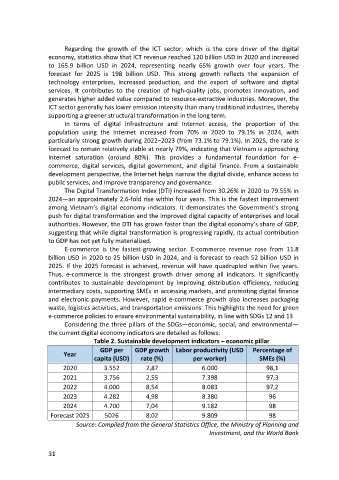
                                  Table 2. Sustainable development indicators – economic pillar
                                    GDP per     GDP growth Labor productivity (USD        Percentage of
                       Year
                                  capita (USD)    rate (%)           per worker)            SMEs (%)
                       2020           3.552         2,87                6.000                  98,1
                       2021           3.756         2,55                7.398                  97,3
                       2022           4.000         8,54                8.083                  97,2
                       2023           4.282         4,98                8.380                  96
                       2024           4.700         7,04                9.182                  98
                   Forecast 2025      5026          8,02                9.809                  98
                            Source: Compiled from the General Statistics Office, the Ministry of Planning and
                                                                           Investment, and the World Bank


                  31

