


Page 28 - ISC PROCEEDINGS 21.4
P. 28
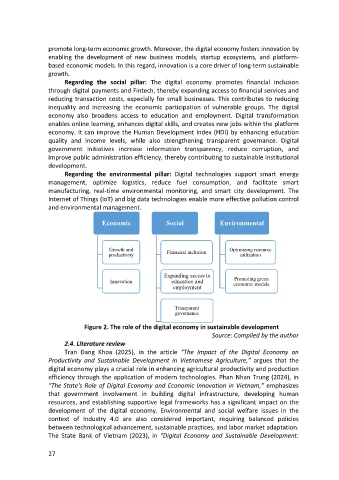
promote long-term economic growth. Moreover, the digital economy fosters innovation by
                  enabling the development of new business models, startup ecosystems, and platform-
                  based economic models. In this regard, innovation is a core driver of long-term sustainable
                  growth.
                        Regarding the social pillar: The digital economy promotes financial inclusion
                  through digital payments and Fintech, thereby expanding access to financial services and
                  reducing transaction costs, especially for small businesses. This contributes to reducing
                  inequality and increasing the economic participation of vulnerable groups. The digital
                  economy also broadens access to education and employment. Digital transformation
                  enables online learning, enhances digital skills, and creates new jobs within the platform
                  economy. It can improve the Human Development Index (HDI) by enhancing education
                  quality and income levels, while also strengthening transparent governance. Digital
                  government initiatives increase information transparency, reduce corruption, and
                  improve public administration efficiency, thereby contributing to sustainable institutional
                  development.
                        Regarding the environmental pillar: Digital technologies support smart energy
                  management, optimize logistics, reduce fuel consumption, and facilitate smart
                  manufacturing, real-time environmental monitoring, and smart city development. The
                  Internet of Things (IoT) and big data technologies enable more effective pollution control
                  and environmental management.


                                     Economic              Social             Environmental


                                       Growth and           Financial inclusion   Optimizing resource
                                       productivity                                  utilization


                                                           Expanding access to
                                                                                   Promoting green
                                        Innovation           education and         economic models
                                                              employment


                                                              Transparent
                                                               governance

                               Figure 2. The role of the digital economy in sustainable development
                                                                           Source: Compiled by the author
                        2.4. Literature review
                        Tran Đang Khoa (2025), in the article “The Impact of the Digital Economy on
                  Productivity and Sustainable Development in Vietnamese Agriculture,” argues that the
                  digital economy plays a crucial role in enhancing agricultural productivity and production
                  efficiency through the application of modern technologies. Phan Nhan Trung (2024), in
                  “The State's Role of Digital Economy and Economic Innovation in Vietnam,” emphasizes
                  that government involvement in building digital infrastructure, developing human
                  resources, and establishing supportive legal frameworks has a significant impact on the
                  development of the digital economy. Environmental and social welfare issues in the
                  context of Industry 4.0 are also considered important, requiring balanced policies
                  between technological advancement, sustainable practices, and labor market adaptation.
                  The State Bank of Vietnam (2023), in “Digital Economy and Sustainable Development:


                  27

