


Page 27 - ISC PROCEEDINGS 21.4
P. 27
that sustainable development is the integration of three pillars: sustainable economy,
                  sustainable society, and sustainable environment. Accordingly, a sustainable economy
                  refers to stable, efficient, and competitive growth. Since 1972, the United Nations has
                  recognized the tension between economic growth and environmental protection.
                  Through important milestones in shaping the concept of sustainable development, in
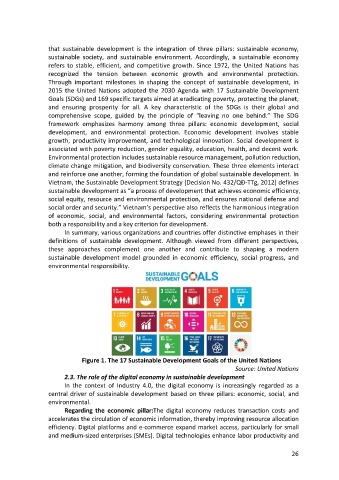
                  2015 the United Nations adopted the 2030 Agenda with 17 Sustainable Development
                  Goals (SDGs) and 169 specific targets aimed at eradicating poverty, protecting the planet,
                  and ensuring prosperity for all. A key characteristic of the SDGs is their global and
                  comprehensive scope, guided by the principle of “leaving no one behind.” The SDG
                  framework emphasizes harmony among three pillars: economic development, social
                  development, and environmental protection. Economic development involves stable
                  growth, productivity improvement, and technological innovation. Social development is
                  associated with poverty reduction, gender equality, education, health, and decent work.
                  Environmental protection includes sustainable resource management, pollution reduction,
                  climate change mitigation, and biodiversity conservation. These three elements interact
                  and reinforce one another, forming the foundation of global sustainable development. In
                  Vietnam, the Sustainable Development Strategy (Decision No. 432/QĐ-TTg, 2012) defines
                  sustainable development as “a process of development that achieves economic efficiency,
                  social equity, resource and environmental protection, and ensures national defense and
                  social order and security.” Vietnam’s perspective also reflects the harmonious integration
                  of economic, social, and environmental factors, considering environmental protection
                  both a responsibility and a key criterion for development.
                        In summary, various organizations and countries offer distinctive emphases in their
                  definitions of sustainable development. Although viewed from different perspectives,
                  these approaches complement one another and contribute to shaping a modern
                  sustainable development model grounded in economic efficiency, social progress, and
                  environmental responsibility.


                              Figure 1. The 17 Sustainable Development Goals of the United Nations
                                                                                    Source: United Nations
                        2.3. The role of the digital economy in sustainable development
                        In the context of Industry 4.0, the digital economy is increasingly regarded as a
                  central driver of sustainable development based on three pillars: economic, social, and
                  environmental.
                        Regarding the economic pillar:The digital economy reduces transaction costs and
                  accelerates the circulation of economic information, thereby improving resource allocation
                  efficiency. Digital platforms and e-commerce expand market access, particularly for small
                  and medium-sized enterprises (SMEs). Digital technologies enhance labor productivity and


                                                                                                       26

