


Page 30 - ISC PROCEEDINGS 21.4
P. 30
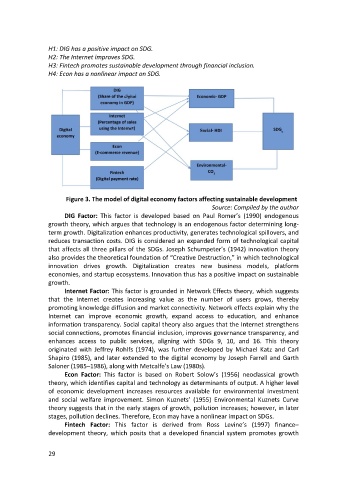
H1: DIG has a positive impact on SDG.
                  H2: The Internet improves SDG.
                  H3: Fintech promotes sustainable development through financial inclusion.
                  H4: Econ has a nonlinear impact on SDG.


                        Figure 3. The model of digital economy factors affecting sustainable development
                                                                           Source: Compiled by the author
                        DIG Factor: This factor is developed based on Paul Romer’s (1990) endogenous
                  growth theory, which argues that technology is an endogenous factor determining long-
                  term growth. Digitalization enhances productivity, generates technological spillovers, and
                  reduces transaction costs. DIG is considered an expanded form of technological capital
                  that affects all three pillars of the SDGs. Joseph Schumpeter’s (1942) innovation theory
                  also provides the theoretical foundation of “Creative Destruction,” in which technological
                  innovation drives growth. Digitalization creates new business models, platform
                  economies, and startup ecosystems. Innovation thus has a positive impact on sustainable
                  growth.
                        Internet Factor: This factor is grounded in Network Effects theory, which suggests
                  that the Internet creates increasing value as the number of users grows, thereby
                  promoting knowledge diffusion and market connectivity. Network effects explain why the
                  Internet can improve economic growth, expand access to education, and enhance
                  information transparency. Social capital theory also argues that the Internet strengthens
                  social connections, promotes financial inclusion, improves governance transparency, and
                  enhances access to public services, aligning with SDGs 9, 10, and 16. This theory
                  originated with Jeffrey Rohlfs (1974), was further developed by Michael Katz and Carl
                  Shapiro (1985), and later extended to the digital economy by Joseph Farrell and Garth
                  Saloner (1985–1986), along with Metcalfe’s Law (1980s).
                        Econ Factor: This factor is based on Robert Solow’s (1956) neoclassical growth
                  theory, which identifies capital and technology as determinants of output. A higher level
                  of economic development increases resources available for environmental investment
                  and social welfare improvement. Simon Kuznets’ (1955) Environmental Kuznets Curve
                  theory suggests that in the early stages of growth, pollution increases; however, in later
                  stages, pollution declines. Therefore, Econ may have a nonlinear impact on SDGs.
                        Fintech Factor: This factor is derived from Ross Levine’s (1997) finance–
                  development theory, which posits that a developed financial system promotes growth


                  29

