


Page 31 - ISC PROCEEDINGS 21.4
P. 31
through efficient capital allocation, reduced information asymmetry, and support for
                  innovation. Fintech expands financial inclusion, contributes to poverty reduction,
                  supports SMEs, and enhances social inclusion. Financial inclusion theory identifies Fintech
                  as enabling vulnerable groups to access digital payments, microcredit, and e-wallets.
                  These elements positively affect SDGs 1, 8, and 9.
                        3. Research methodology
                        This study combines qualitative and quantitative research methods to clarify the
                  research objectives. The qualitative method is employed to examine the current state of
                  the digital economy in promoting sustainable development in Vietnam, thereby
                  highlighting the role of the digital economy during the 2020–2025 period. The
                  quantitative method is used to test the measurement scales and the proposed research
                  model of digital economy factors affecting sustainable development. The scales and the
                  model are evaluated using the following tools: Cronbach’s Alpha reliability test,
                  Exploratory Factor Analysis (EFA), and linear regression analysis. The research results are
                  based on a survey of 300 respondents, including managers and economic experts in
                  Vietnam. The survey was conducted from October 1, 2025 to December 31, 2025.
                        4. Research results
                        4.1. The current situation of the digital economy in sustainable development in
                  Vietnam
                        Overall, the current state of the digital economy in sustainable development in
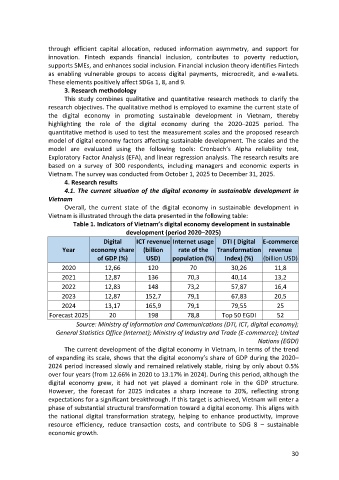
                  Vietnam is illustrated through the data presented in the following table:
                           Table 1. Indicators of Vietnam’s digital economy development in sustainable
                                             development (period 2020–2025)
                                     Digital     ICT revenue Internet usage    DTI ( Digital  E-commerce
                       Year      economy share     (billion     rate of the  Transformation    revenue
                                   of GDP (%)       USD)      population (%)    Index) (%)   (billion USD)
                       2020           12,66          120            70            30,26          11,8
                       2021           12,87          136           70,3           40,14          13,2
                       2022           12,83          148           73,2           57,87          16,4
                       2023           12,87         152,7          79,1           67,83          20,5
                       2024           13,17         165,9          79,1           79,55           25
                  Forecast 2025        20            198           78,8        Top 50 EGDI        52
                            Source: Ministry of Information and Communications (DTI, ICT, digital economy);
                     General Statistics Office (Internet); Ministry of Industry and Trade (E-commerce); United
                                                                                            Nations (EGDI)
                        The current development of the digital economy in Vietnam, in terms of the trend
                  of expanding its scale, shows that the digital economy’s share of GDP during the 2020–
                  2024 period increased slowly and remained relatively stable, rising by only about 0.5%
                  over four years (from 12.66% in 2020 to 13.17% in 2024). During this period, although the
                  digital economy grew, it had not yet played a dominant role in the GDP structure.
                  However, the forecast for 2025 indicates a sharp increase to 20%, reflecting strong
                  expectations for a significant breakthrough. If this target is achieved, Vietnam will enter a
                  phase of substantial structural transformation toward a digital economy. This aligns with
                  the national digital transformation strategy, helping to enhance productivity, improve
                  resource efficiency, reduce transaction costs, and contribute to SDG 8 – sustainable
                  economic growth.


                                                                                                       30

