


Page 33 - ISC PROCEEDINGS 21.4
P. 33
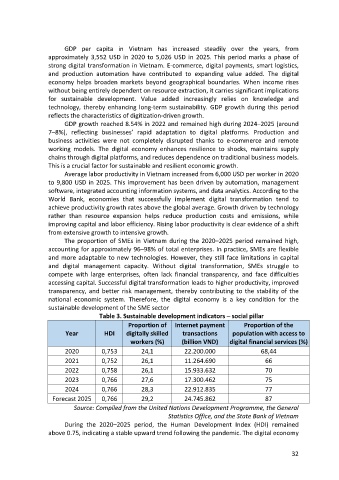
GDP per capita in Vietnam has increased steadily over the years, from
                  approximately 3,552 USD in 2020 to 5,026 USD in 2025. This period marks a phase of
                  strong digital transformation in Vietnam. E-commerce, digital payments, smart logistics,
                  and production automation have contributed to expanding value added. The digital
                  economy helps broaden markets beyond geographical boundaries. When income rises
                  without being entirely dependent on resource extraction, it carries significant implications
                  for sustainable development. Value added increasingly relies on knowledge and
                  technology, thereby enhancing long-term sustainability. GDP growth during this period
                  reflects the characteristics of digitization-driven growth.
                        GDP growth reached 8.54% in 2022 and remained high during 2024–2025 (around
                  7–8%), reflecting businesses’ rapid adaptation to digital platforms. Production and
                  business activities were not completely disrupted thanks to e-commerce and remote
                  working models. The digital economy enhances resilience to shocks, maintains supply
                  chains through digital platforms, and reduces dependence on traditional business models.
                  This is a crucial factor for sustainable and resilient economic growth.
                        Average labor productivity in Vietnam increased from 6,000 USD per worker in 2020
                  to 9,800 USD in 2025. This improvement has been driven by automation, management
                  software, integrated accounting information systems, and data analytics. According to the
                  World Bank, economies that successfully implement digital transformation tend to
                  achieve productivity growth rates above the global average. Growth driven by technology
                  rather than resource expansion helps reduce production costs and emissions, while
                  improving capital and labor efficiency. Rising labor productivity is clear evidence of a shift
                  from extensive growth to intensive growth.
                        The proportion of SMEs in Vietnam during the 2020–2025 period remained high,
                  accounting for approximately 96–98% of total enterprises. In practice, SMEs are flexible
                  and more adaptable to new technologies. However, they still face limitations in capital
                  and digital management capacity. Without digital transformation, SMEs struggle to
                  compete with large enterprises, often lack financial transparency, and face difficulties
                  accessing capital. Successful digital transformation leads to higher productivity, improved
                  transparency, and better risk management, thereby contributing to the stability of the
                  national economic system. Therefore, the digital economy is a key condition for the
                  sustainable development of the SME sector
                                    Table 3. Sustainable development indicators – social pillar
                                              Proportion of   Internet payment         Proportion of the
                        Year          HDI    digitally skilled   transactions      population with access to
                                               workers (%)       (billion VND)    digital financial services (%)
                        2020         0,753         24,1           22.200.000                 68,44
                        2021         0,752         26,1           11.264.690                  66
                        2022         0,758         26,1           15.933.632                  70
                        2023         0,766         27,6           17.300.462                  75
                        2024         0,766         28,3           22.912.835                  77
                   Forecast 2025     0,766         29,2           24.745.862                  87
                           Source: Compiled from the United Nations Development Programme, the General
                                                            Statistics Office, and the State Bank of Vietnam
                        During the 2020–2025 period, the Human Development Index (HDI) remained
                  above 0.75, indicating a stable upward trend following the pandemic. The digital economy


                                                                                                       32

