


Page 35 - ISC PROCEEDINGS 21.4
P. 35
million tons to 75 million tons, reflecting a stronger push for energy transition, the
                  application of digital technologies in emissions monitoring and management, and the
                  implementation of commitments made at COP26 to achieve net-zero emissions by 2050.
                        To achieve this goal, Vietnam must apply IoT and AI in energy management and
                  supply chains, carbon accounting, real-time emissions data tracking, promote the sharing
                  economy and e-commerce, and reduce traditional transportation costs.
                        With the target of reducing emissions per GDP by 15.8% (domestic resources) and
                  43.5% (with international support) by 2030 compared to 2021 levels, Vietnam has
                  strengthened its commitments toward sustainable development. Achieving these targets
                  depends heavily on international finance and technology. The digital economy plays a
                  bridging role in improving energy efficiency, enabling smart manufacturing, optimizing
                  logistics through big data, and developing digital-based Measurement, Reporting, and
                  Verification (MRV) systems. As a result, GDP can grow rapidly while emissions per unit of
                  GDP decline—this is the core of green growth.
                        The proportion of Vietnamese enterprises adopting green technologies remained
                  relatively low in 2020–2021, at around 20–21%, but has shown a steady upward trend in
                  subsequent years. The target for 2025 is 74%. This trend indicates that digital
                  transformation and green transformation are progressing in parallel, reflected in the
                  adoption of e-invoices, digital governance systems, automation, and smart renewable
                  energy solutions.
                        During 2020–2025, Vietnam’s EPI ranking remained very low, at 180/180. This
                  suggests that environmental performance and enforcement effectiveness still face
                  considerable limitations. The digital economy has not yet been implemented in a
                  synchronized manner at the national level, particularly due to the lack of integrated
                  environmental data, fragmented monitoring systems, and insufficient connectivity among
                  enterprises, local authorities, and central government agencies. Therefore, achieving
                  substantive sustainable development requires a digital government for environmental
                  management, a national environmental database, and a green innovation ecosystem
                        4.2. Model testing results of digital economy factors affecting sustainable
                  development in Vietnam
                        4.2.1. Cronbach’s alpha test results
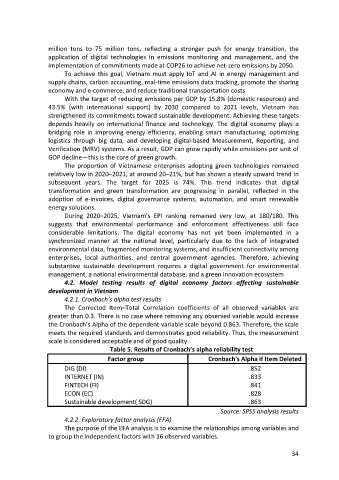
                        The Corrected Item–Total Correlation coefficients of all observed variables are
                  greater than 0.3. There is no case where removing any observed variable would increase
                  the Cronbach’s Alpha of the dependent variable scale beyond 0.863. Therefore, the scale
                  meets the required standards and demonstrates good reliability. Thus, the measurement
                  scale is considered acceptable and of good quality.
                                        Table 5. Results of Cronbach’s alpha reliability test
                                       Factor group                       Cronbach's Alpha if Item Deleted
                        DIG (DI)                                                        .852
                        INTERNET (IN)                                                   .833
                        FINTECH (FI)                                                    .841
                        ECON (EC)                                                       .828
                        Sustainable development( SDG)                                   .863
                                                                              Source: SPSS analysis results
                        4.2.2. Exploratory factor analysis (EFA)
                        The purpose of the EFA analysis is to examine the relationships among variables and
                  to group the independent factors with 16 observed variables.

                                                                                                       34

