


Page 378 - ISC PROCEEDINGS 21.4
P. 378
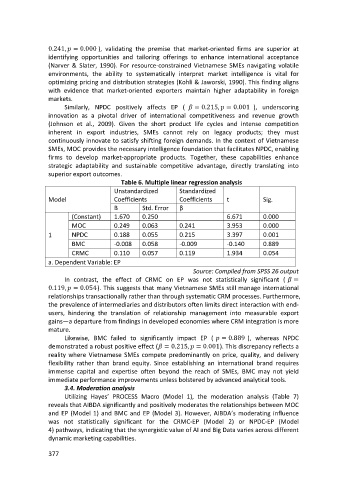
0.241,   = 0.000 ), validating the premise that market-oriented firms are superior at
                  identifying opportunities and tailoring offerings to enhance international acceptance
                  (Narver & Slater, 1990). For resource-constrained Vietnamese SMEs navigating volatile
                  environments, the ability to systematically interpret market intelligence is vital for
                  optimizing pricing and distribution strategies (Kohli & Jaworski, 1990). This finding aligns
                  with evidence that market-oriented exporters maintain higher adaptability in foreign
                  markets.
                        Similarly, NPDC positively affects EP (   = 0.215,   = 0.001 ), underscoring
                  innovation as a pivotal driver of international competitiveness and revenue growth
                  (Johnson et al., 2009). Given the short product life cycles and intense competition
                  inherent in export industries, SMEs cannot rely on legacy products; they must
                  continuously innovate to satisfy shifting foreign demands. In the context of Vietnamese
                  SMEs, MOC provides the necessary intelligence foundation that facilitates NPDC, enabling
                  firms to develop market-appropriate products. Together, these capabilities enhance
                  strategic adaptability and sustainable competitive advantage, directly translating into
                  superior export outcomes.
                                            Table 6. Multiple linear regression analysis
                                         Unstandardized         Standardized
                  Model                  Coefficients           Coefficients     t           Sig.
                                         B         Std. Error   β
                          (Constant)     1.670     0.250                         6.671       0.000
                          MOC            0.249     0.063        0.241            3.953       0.000
                  1       NPDC           0.188     0.055        0.215            3.397       0.001
                          BMC            -0.008    0.058        -0.009           -0.140      0.889
                          CRMC           0.110     0.057        0.119            1.934       0.054
                  a. Dependent Variable: EP
                                                                     Source: Compiled from SPSS 26 output

                        In contrast, the effect of CRMC on EP was not statistically significant (   =
                  0.119,   = 0.054). This suggests that many Vietnamese SMEs still manage international
                  relationships transactionally rather than through systematic CRM processes. Furthermore,
                  the prevalence of intermediaries and distributors often limits direct interaction with end-
                  users, hindering the translation of relationship management into measurable export
                  gains—a departure from findings in developed economies where CRM integration is more
                  mature.
                        Likewise, BMC failed to significantly impact EP (   = 0.889 ), whereas NPDC
                  demonstrated a robust positive effect (  = 0.215,   = 0.001). This discrepancy reflects a
                  reality where Vietnamese SMEs compete predominantly on price, quality, and delivery
                  flexibility rather than brand equity. Since establishing an international brand requires
                  immense capital and expertise often beyond the reach of SMEs, BMC may not yield
                  immediate performance improvements unless bolstered by advanced analytical tools.
                        3.4. Moderation analysis
                        Utilizing Hayes’ PROCESS Macro (Model 1), the moderation analysis (Table 7)
                  reveals that AIBDA significantly and positively moderates the relationships between MOC
                  and EP (Model 1) and BMC and EP (Model 3). However, AIBDA’s moderating influence
                  was not statistically significant for the CRMC-EP (Model 2) or NPDC-EP (Model
                  4) pathways, indicating that the synergistic value of AI and Big Data varies across different
                  dynamic marketing capabilities.

                  377

