


Page 373 - ISC PROCEEDINGS 21.4
P. 373
2.3. Methodology
                        2.3.1. Measurement
                        This study employs a quantitative survey design, utilizing measurement scales
                  adapted from established academic literature to ensure high validity and reliability. To
                  achieve semantic and conceptual equivalence, all items underwent a rigorous translation
                  and back-translation process conducted by independent professional linguists. Constructs
                  were measured using a five-point Likert scale, ranging from 1 (Strongly disagree) to 5
                  (Strongly agree). Furthermore, a pilot test with 10–15 business managers was conducted
                  to refine the items for clarity and contextual appropriateness within the Vietnamese SME
                  environment. The complete list of items and sources is available in Appendix 1.
                        2.3.2. Sample and data collection
                        The target population comprises senior managers (e.g., directors, department heads)
                  from export-oriented SMEs in Vietnam that have integrated Artificial Intelligence and Big
                  Data Analytics (AIBDA) into their operations. Due to the lack of a comprehensive public
                  database of such firms, a combination of purposive and snowball sampling was employed.
                  Critically, AIBDA is treated not as a binary adoption variable, but as a continuous
                  construct reflecting the maturity and intensity of its integration into activities such as
                  market sensing, forecasting, and decision-making. Higher scores, therefore, indicate more
                  advanced and systematic utilization.
                        Data were collected via face-to-face interview-based surveys to maximize response
                  rates and ensure data precision by allowing for real-time clarification, thereby reducing
                  non-response bias (Sekaran, 1984). To mitigate common method bias, several procedural
                  remedies    were   implemented:    respondents    were    guaranteed   anonymity    and
                  confidentiality, independent and dependent variables were placed in separate sections,
                  and neutral wording was used to minimize evaluation apprehension. Each participant
                  received a cover letter explaining the study’s scope and voluntary nature. Sample
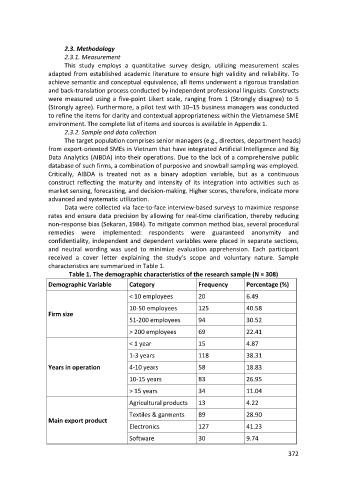
                  characteristics are summarized in Table 1.
                         Table 1. The demographic characteristics of the research sample (N = 308)
                  Demographic Variable        Category                 Frequency        Percentage (%)

                                              < 10 employees           20               6.49
                                              10-50 employees          125              40.58
                  Firm size
                                              51-200 employees         94               30.52

                                              > 200 employees          69               22.41
                                              < 1 year                 15               4.87

                                              1-3 years                118              38.31
                  Years in operation          4-10 years               58               18.83

                                              10-15 years              83               26.95

                                              > 15 years               34               11.04
                                              Agricultural products    13               4.22

                                              Textiles & garments      89               28.90
                  Main export product
                                              Electronics              127              41.23

                                              Software                 30               9.74

                                                                                                      372

