


Page 379 - ISC PROCEEDINGS 21.4
P. 379
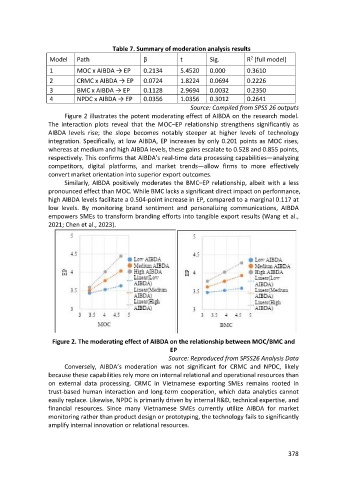
Table 7. Summary of moderation analysis results
                  Model     Path                   β            t          Sig.         R (full model)
                                                                                         2
                  1         MOC x AIBDA → EP       0.2134       5.4520     0.000        0.3610

                  2         CRMC x AIBDA → EP      0.0724       1.8224     0.0694       0.2226
                  3         BMC x AIBDA → EP       0.1128       2.9694     0.0032       0.2350
                  4         NPDC x AIBDA → EP      0.0356       1.0356     0.3012       0.2641
                                                                    Source: Compiled from SPSS 26 outputs
                        Figure 2 illustrates the potent moderating effect of AIBDA on the research model.
                  The interaction plots reveal that the MOC–EP relationship strengthens significantly as
                  AIBDA levels rise; the slope becomes notably steeper at higher levels of technology
                  integration. Specifically, at low AIBDA, EP increases by only 0.201 points as MOC rises,
                  whereas at medium and high AIBDA levels, these gains escalate to 0.528 and 0.855 points,
                  respectively. This confirms that AIBDA’s real-time data processing capabilities—analyzing
                  competitors, digital platforms, and market trends—allow firms to more effectively
                  convert market orientation into superior export outcomes.
                        Similarly, AIBDA positively moderates the BMC–EP relationship, albeit with a less
                  pronounced effect than MOC. While BMC lacks a significant direct impact on performance,
                  high AIBDA levels facilitate a 0.504-point increase in EP, compared to a marginal 0.117 at
                  low levels. By monitoring brand sentiment and personalizing communications, AIBDA
                  empowers SMEs to transform branding efforts into tangible export results (Wang et al.,
                  2021; Chen et al., 2023).


                   Figure 2. The moderating effect of AIBDA on the relationship between MOC/BMC and
                                                             EP
                                                            Source: Reproduced from SPSS26 Analysis Data
                        Conversely, AIBDA’s moderation was not significant for CRMC and NPDC, likely
                  because these capabilities rely more on internal relational and operational resources than
                  on external data processing. CRMC in Vietnamese exporting SMEs remains rooted in
                  trust-based human interaction and long-term cooperation, which data analytics cannot
                  easily replace. Likewise, NPDC is primarily driven by internal R&D, technical expertise, and
                  financial resources. Since many Vietnamese SMEs currently utilize AIBDA for market
                  monitoring rather than product design or prototyping, the technology fails to significantly
                  amplify internal innovation or relational resources.


                                                                                                      378

