


Page 344 - ISC PROCEEDINGS 21.4
P. 344
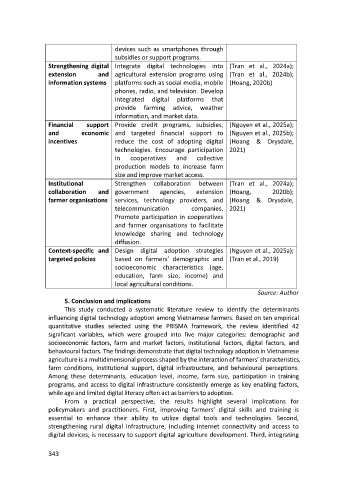
devices such as smartphones through
                                         subsidies or support programs.
                  Strengthening digital Integrate digital technologies into (Tran et al., 2024a);
                  extension        and agricultural extension programs using (Tran et al., 2024b);
                  information systems    platforms such as social media, mobile (Hoang, 2020b)
                                         phones, radio, and television. Develop
                                         integrated   digital  platforms   that
                                         provide    farming   advice,  weather
                                         information, and market data.
                  Financial    support Provide credit programs, subsidies, (Nguyen et al., 2025a);
                  and         economic and targeted financial support to (Nguyen et al., 2025b);
                  incentives             reduce the cost of adopting digital (Hoang        &   Drysdale,
                                         technologies. Encourage participation 2021)
                                         in    cooperatives    and    collective
                                         production models to increase farm
                                         size and improve market access.
                  Institutional          Strengthen    collaboration   between (Tran et al., 2024a);
                  collaboration    and government        agencies,    extension (Hoang,          2020b);
                  farmer organisations   services, technology providers, and (Hoang        &   Drysdale,
                                         telecommunication          companies. 2021)
                                         Promote participation in cooperatives
                                         and farmer organisations to facilitate
                                         knowledge sharing and technology
                                         diffusion.
                  Context-specific and Design digital adoption strategies (Nguyen et al., 2025a);
                  targeted policies      based on farmers’ demographic and (Tran et al., 2019)
                                         socioeconomic characteristics (age,
                                         education, farm size, income) and
                                         local agricultural conditions.
                                                                                            Source: Author
                        5. Conclusion and implications
                        This study conducted a systematic literature review to identify the determinants
                  influencing digital technology adoption among Vietnamese farmers. Based on ten empirical
                  quantitative studies selected using the PRISMA framework, the review identified 42
                  significant variables, which were grouped into five major categories: demographic and
                  socioeconomic factors, farm and market factors, institutional factors, digital factors, and
                  behavioural factors. The findings demonstrate that digital technology adoption in Vietnamese
                  agriculture is a multidimensional process shaped by the interaction of farmers’ characteristics,
                  farm conditions, institutional support, digital infrastructure, and behavioural perceptions.
                  Among these determinants, education level, income, farm size, participation in training
                  programs, and access to digital infrastructure consistently emerge as key enabling factors,
                  while age and limited digital literacy often act as barriers to adoption.
                        From a practical perspective, the results highlight several implications for
                  policymakers and practitioners. First, improving farmers’ digital skills and training is
                  essential to enhance their ability to utilize digital tools and technologies. Second,
                  strengthening rural digital infrastructure, including internet connectivity and access to
                  digital devices, is necessary to support digital agriculture development. Third, integrating


                  343

