


Page 779 - ISC PROCEEDINGS 21.4
P. 779
0.001), confirming that the correlation matrix is not an identity matrix. These results
                  demonstrate that the dataset is appropriate for factor analysis and supports the
                  extraction of latent constructs in the research model.
                        Factor extraction results (Total Variance Explained)s
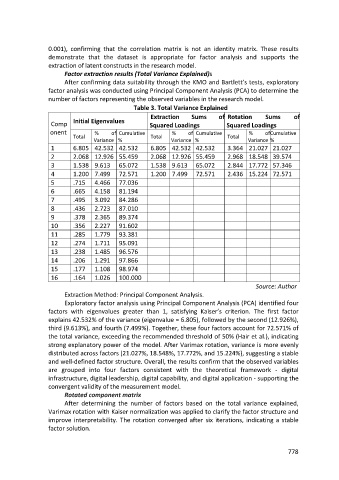
                        After confirming data suitability through the KMO and Bartlett’s tests, exploratory
                  factor analysis was conducted using Principal Component Analysis (PCA) to determine the
                  number of factors representing the observed variables in the research model.
                                                Table 3. Total Variance Explained
                                                      Extraction    Sums      of Rotation     Sums      of
                   Comp    Initial Eigenvalues        Squared Loadings           Squared Loadings
                   onent          %     of Cumulative        %     of Cumulative        %     ofCumulative
                           Total                      Total                      Total
                                  Variance %                 Variance %                 Variance %
                   1       6.805 42.532 42.532        6.805 42.532 42.532        3.364 21.027 21.027
                   2       2.068 12.926 55.459        2.068 12.926 55.459        2.968 18.548 39.574
                   3       1.538 9.613     65.072     1.538 9.613     65.072     2.844 17.772 57.346
                   4       1.200 7.499     72.571     1.200 7.499     72.571     2.436 15.224 72.571
                   5       .715   4.466    77.036
                   6       .665   4.158    81.194
                   7       .495   3.092    84.286
                   8       .436   2.723    87.010
                   9       .378   2.365    89.374
                   10      .356   2.227    91.602
                   11      .285   1.779    93.381
                   12      .274   1.711    95.091
                   13      .238   1.485    96.576
                   14      .206   1.291    97.866
                   15      .177   1.108    98.974
                   16      .164   1.026    100.000
                                                                                           Source: Author
                        Extraction Method: Principal Component Analysis.
                        Exploratory factor analysis using Principal Component Analysis (PCA) identified four
                  factors with eigenvalues greater than 1, satisfying Kaiser’s criterion. The first factor
                  explains 42.532% of the variance (eigenvalue = 6.805), followed by the second (12.926%),
                  third (9.613%), and fourth (7.499%). Together, these four factors account for 72.571% of
                  the total variance, exceeding the recommended threshold of 50% (Hair et al.), indicating
                  strong explanatory power of the model. After Varimax rotation, variance is more evenly
                  distributed across factors (21.027%, 18.548%, 17.772%, and 15.224%), suggesting a stable
                  and well-defined factor structure. Overall, the results confirm that the observed variables
                  are grouped into four factors consistent with the theoretical framework - digital
                  infrastructure, digital leadership, digital capability, and digital application - supporting the
                  convergent validity of the measurement model.
                        Rotated component matrix
                        After determining the number of factors based on the total variance explained,
                  Varimax rotation with Kaiser normalization was applied to clarify the factor structure and
                  improve interpretability. The rotation converged after six iterations, indicating a stable
                  factor solution.


                                                                                                      778

