


Page 782 - ISC PROCEEDINGS 21.4
P. 782
human resource management in tourism cooperatives. Overall, the ANOVA results
                  support the validity of the regression model for subsequent coefficient analysis.
                        Regression coefficient analysis
                        After confirming the overall suitability of the regression model, the regression
                  coefficients were analyzed to determine the magnitude and direction of the effects of
                  digital transformation factors on Sustainable Human Resource Management (SHRM) in
                  tourism cooperatives in Bac Ninh Province.
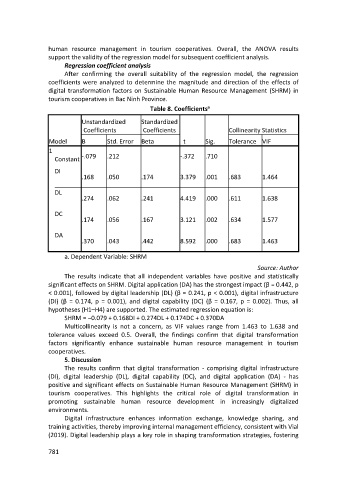
                                                      Table 8. Coefficients a

                              Unstandardized       Standardized
                              Coefficients         Coefficients                  Collinearity Statistics
                  Model       B        Std. Error  Beta          t       Sig.    Tolerance VIF
                  1
                    Constant  -.079    .212                     -.372    .710
                    DI
                              .168     .050        .174         3.379    .001    .683        1.464

                    DL
                              .274     .062        .241         4.419    .000    .611        1.638


                    DC
                              .174     .056        .167         3.121    .002    .634        1.577

                    DA
                              .370     .043        .442         8.592    .000    .683        1.463

                        a. Dependent Variable: SHRM

                                                                                           Source: Author
                        The results indicate that all independent variables have positive and statistically
                  significant effects on SHRM. Digital application (DA) has the strongest impact (β = 0.442, p
                  < 0.001), followed by digital leadership (DL) (β = 0.241, p < 0.001), digital infrastructure
                  (DI) (β = 0.174, p = 0.001), and digital capability (DC) (β = 0.167, p = 0.002). Thus, all
                  hypotheses (H1–H4) are supported. The estimated regression equation is:
                        SHRM = −0.079 + 0.168DI + 0.274DL + 0.174DC + 0.370DA
                        Multicollinearity is not a concern, as VIF values range from 1.463 to 1.638 and
                  tolerance values exceed 0.5. Overall, the findings confirm that digital transformation
                  factors significantly enhance sustainable human resource management in tourism
                  cooperatives.
                        5. Discussion
                        The results confirm that digital transformation - comprising digital infrastructure
                  (DI), digital leadership (DL), digital capability (DC), and digital application (DA) - has
                  positive and significant effects on Sustainable Human Resource Management (SHRM) in
                  tourism cooperatives. This highlights the critical role of digital transformation in
                  promoting sustainable human resource development in increasingly digitalized
                  environments.
                        Digital infrastructure enhances information exchange, knowledge sharing, and
                  training activities, thereby improving internal management efficiency, consistent with Vial
                  (2019). Digital leadership plays a key role in shaping transformation strategies, fostering


                  781

