


Page 777 - ISC PROCEEDINGS 21.4
P. 777
H2: Digital leadership positively affects SHRM.
                        H3: Digital capability positively affects SHRM.
                        H4: Digital application positively affects SHRM.
                        3. Research methodology
                        3.1. Research model
                        Based on prior studies on digital transformation and SHRM, this study examines the
                  impact of four dimensions - digital infrastructure (DI), digital leadership (DL), digital
                  capability (DC), and digital application (DA) - on sustainable human resource management
                  in tourism cooperatives (Vial, 2021; Verhoef et al., 2021; Kane et al., 2019).
                        Digital infrastructure reflects technological readiness, digital leadership captures
                  managerial ability to drive transformation, digital capability represents employees’ ability
                  to utilize digital technologies, and digital application measures the extent of technology
                  use in operations. These factors are expected to positively influence SHRM, defined as
                  enhancing employees’ competencies and adaptability in dynamic environments (Aust et
                  al., 2020).
                        Given the exploratory nature of the study and the sample size (n = 200), EFA and
                  multiple regression are employed to ensure parsimony and empirical interpretability,
                  while future studies may adopt SEM for further validation.
                        3.2. Data collection
                        Data were collected from 200 members of tourism cooperatives in Bac Ninh
                  Province, Vietnam-a context characterized by growing digital adoption in tourism
                  activities. A structured questionnaire, adapted from prior studies, was employed, with a
                  pilot test conducted to ensure clarity. All variables were measured using a five-point
                  Likert scale.
                        3.3. Measurement of variables
                        Measurement scales were adapted from validated studies. Digital infrastructure (DI)
                  was measured based on Vial (2021), digital leadership (DL) on Kane et al. (2019), while
                  digital capability (DC) and digital application (DA) were adapted from prior digital
                  transformation studies.
                        The dependent variable, sustainable human resource management (SHRM), was
                  measured through three dimensions: human resource development, employment
                  stability and fairness, and participation and collaboration (Ehnert, 2009; Kramar, 2014;
                  Aust et al., 2020). Reliability and validity were assessed using Cronbach’s Alpha and EFA,
                  followed by multiple regression analysis to test the hypotheses.
                        4. Results
                        4.1. Reliability analysis
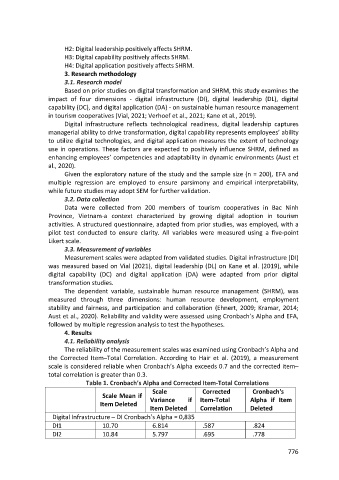
                        The reliability of the measurement scales was examined using Cronbach’s Alpha and
                  the Corrected Item–Total Correlation. According to Hair et al. (2019), a measurement
                  scale is considered reliable when Cronbach’s Alpha exceeds 0.7 and the corrected item–
                  total correlation is greater than 0.3.
                               Table 1. Cronbach’s Alpha and Corrected Item-Total Correlations
                                                       Scale            Corrected         Cronbach's
                                     Scale Mean if
                                    Item Deleted      Variance     if  Item-Total        Alpha if Item
                                                      Item Deleted     Correlation       Deleted
                   Digital Infrastructure – DI Cronbach’s Alpha = 0,835
                   DI1               10.70             6.814            .587              .824
                   DI2               10.84             5.797            .695              .778


                                                                                                      776

