


Page 543 - ISC PROCEEDINGS 21.4
P. 543
4.3.2. Hypothesis testing and discussion
                        Hair et al. (2022) explain that path coefficients (β) reflect the magnitude and
                  direction of links between constructs, whereas t-statistics and p-values assess statistical
                  significance. The findings support all eight hypotheses at standard significance thresholds
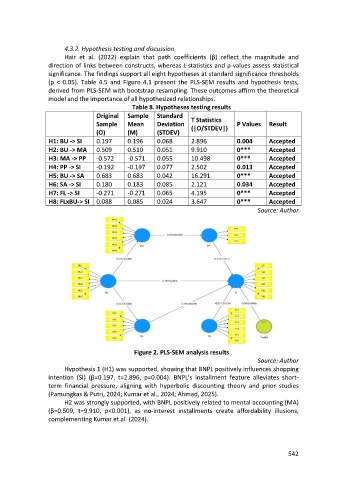
                  (p < 0.05). Table 4.5 and Figure 4.1 present the PLS-SEM results and hypothesis tests,
                  derived from PLS-SEM with bootstrap resampling. These outcomes affirm the theoretical
                  model and the importance of all hypothesized relationships.
                                               Table 8. Hypotheses testing results
                                   Original   Sample    Standard
                                   Sample     Mean      Deviation   T Statistics    P Values   Result
                                                                    (|O/STDEV|)
                                   (O)        (M)       (STDEV)
                  H1: BU -> SI     0.197      0.196     0.068       2.896           0.004      Accepted
                  H2: BU -> MA     0.509      0.510     0.051       9.910           0***       Accepted
                  H3: MA -> PP     -0.572     -0.571    0.055       10.498          0***       Accepted
                  H4: PP -> SI     -0.192     -0.197    0.077       2.502           0.013      Accepted
                  H5: BU -> SA     0.683      0.683     0.042       16.291          0***       Accepted
                  H6: SA -> SI     0.180      0.183     0.085       2.121           0.034      Accepted
                  H7: FL -> SI     -0.271     -0.271    0.065       4.195           0***       Accepted
                  H8: FLxBU-> SI   0.088      0.085     0.024       3.647           0***       Accepted
                                                                                            Source: Author


                                                Figure 2. PLS-SEM analysis results
                                                                                            Source: Author
                        Hypothesis 1 (H1) was supported, showing that BNPL positively influences shopping
                  intention (SI) (β=0.197, t=2.896, p=0.004). BNPL's installment feature alleviates short-
                  term financial pressure, aligning with hyperbolic discounting theory and prior studies
                  (Pamungkas & Putri, 2024; Kumar et al., 2024; Ahmad, 2025).
                        H2 was strongly supported, with BNPL positively related to mental accounting (MA)
                  (β=0.509, t=9.910, p<0.001), as no-interest installments create affordability illusions,
                  complementing Kumar et al. (2024).


                                                                                                      542

