


Page 539 - ISC PROCEEDINGS 21.4
P. 539
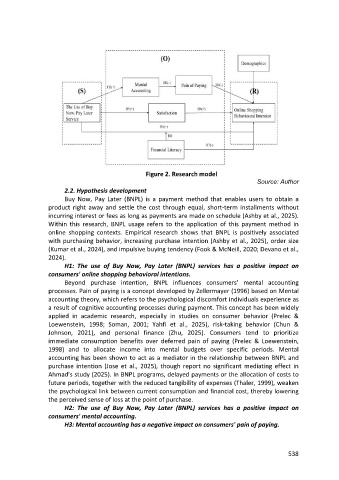
Figure 2. Research model
                                                                                           Source: Author
                        2.2. Hypothesis development
                        Buy Now, Pay Later (BNPL) is a payment method that enables users to obtain a
                  product right away and settle the cost through equal, short-term installments without
                  incurring interest or fees as long as payments are made on schedule (Ashby et al., 2025).
                  Within this research, BNPL usage refers to the application of this payment method in
                  online shopping contexts. Empirical research shows that BNPL is positively associated
                  with purchasing behavior, increasing purchase intention (Ashby et al., 2025), order size
                  (Kumar et al., 2024), and impulsive buying tendency (Fook & McNeill, 2020; Devano et al.,
                  2024).
                        H1: The use of Buy Now, Pay Later (BNPL) services has a positive impact on
                  consumers' online shopping behavioral intentions.
                        Beyond purchase intention, BNPL influences consumers’ mental accounting
                  processes. Pain of paying is a concept developed by Zellermayer (1996) based on Mental
                  accounting theory, which refers to the psychological discomfort individuals experience as
                  a result of cognitive accounting processes during payment. This concept has been widely
                  applied in academic research, especially in studies on consumer behavior (Prelec &
                  Loewenstein, 1998; Soman, 2001; Yahfi et al., 2025), risk-taking behavior (Chun &
                  Johnson, 2021), and personal finance (Zhu, 2025). Consumers tend to prioritize
                  immediate consumption benefits over deferred pain of paying (Prelec & Loewenstein,
                  1998) and to allocate income into mental budgets over specific periods. Mental
                  accounting has been shown to act as a mediator in the relationship between BNPL and
                  purchase intention (Jose et al., 2025), though report no significant mediating effect in
                  Ahmad’s study (2025). In BNPL programs, delayed payments or the allocation of costs to
                  future periods, together with the reduced tangibility of expenses (Thaler, 1999), weaken
                  the psychological link between current consumption and financial cost, thereby lowering
                  the perceived sense of loss at the point of purchase.
                        H2: The use of Buy Now, Pay Later (BNPL) services has a positive impact on
                  consumers' mental accounting.
                        H3: Mental accounting has a negative impact on consumers' pain of paying.


                                                                                                      538

