


Page 466 - ISC PROCEEDINGS 21.4
P. 466
engagement in a healthy behavior, such as financial costs, time constraints,
                  inconvenience, or distrust in service quality (Rosenstock, 1974). Numerous studies have
                  identified perceived barriers as the most powerful deterrent to preventive healthcare
                  adoption (Champion and Skinner, 2008). In healthcare service contexts, higher perceived
                  barriers have been shown to significantly weaken positive attitudes toward service
                  utilization (Ong et al., 2023). In Vietnam, despite policy support for family doctor services,
                  barriers related to accessibility, insurance coverage, convenience, and trust remain
                  prominent, potentially undermining favorable evaluations. Based on these considerations,
                  the following hypothesis is proposed:
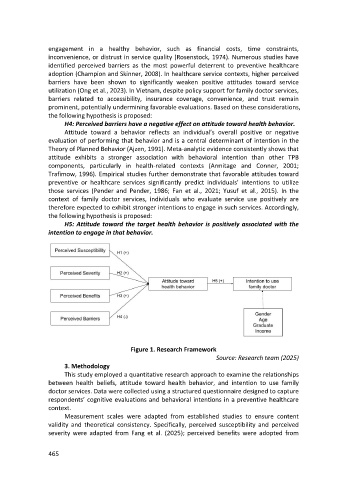
                        H4: Perceived barriers have a negative effect on attitude toward health behavior.
                        Attitude toward a behavior reflects an individual’s overall positive or negative
                  evaluation of performing that behavior and is a central determinant of intention in the
                  Theory of Planned Behavior (Ajzen, 1991). Meta-analytic evidence consistently shows that
                  attitude exhibits a stronger association with behavioral intention than other TPB
                  components, particularly in health-related contexts (Armitage and Conner, 2001;
                  Trafimow, 1996). Empirical studies further demonstrate that favorable attitudes toward
                  preventive or healthcare services significantly predict individuals’ intentions to utilize
                  those services (Pender and Pender, 1986; Fan et al., 2021; Yusuf et al., 2015). In the
                  context of family doctor services, individuals who evaluate service use positively are
                  therefore expected to exhibit stronger intentions to engage in such services. Accordingly,
                  the following hypothesis is proposed:
                        H5: Attitude toward the target health behavior is positively associated with the
                  intention to engage in that behavior.


                                               Figure 1. Research Framework
                                                                             Source: Research team (2025)
                        3. Methodology
                        This study employed a quantitative research approach to examine the relationships
                  between health beliefs, attitude toward health behavior, and intention to use family
                  doctor services. Data were collected using a structured questionnaire designed to capture
                  respondents’ cognitive evaluations and behavioral intentions in a preventive healthcare
                  context.
                        Measurement scales were adapted from established studies to ensure content
                  validity and theoretical consistency. Specifically, perceived susceptibility and perceived
                  severity were adapted from Fang et al. (2025); perceived benefits were adopted from


                  465

