


Page 471 - ISC PROCEEDINGS 21.4
P. 471
perceived barriers significantly influenced attitude toward health behavior, whereas
                  perceived susceptibility did not show a statistically significant effect. Attitude, in turn,
                  significantly predicted intention to use family doctor services.
                        Demographic differences in Intention to use Family doctor services
                        To further explore whether intention to use family doctor services varied across
                  demographic characteristics, additional analyses using independent-samples t-tests and
                  one-way ANOVA were conducted.
                        The results indicate that intention to use family doctor services is largely consistent
                  across gender, age, and occupation. No significant differences were observed between
                  males and females (p = 0.720 > 0.05), nor across age groups (F = 2.157, p = 0.072) or
                  occupational categories (F = 1.218, p = 0.295).
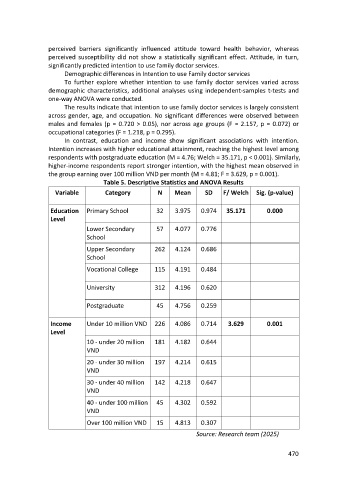
                        In contrast, education and income show significant associations with intention.
                  Intention increases with higher educational attainment, reaching the highest level among
                  respondents with postgraduate education (M = 4.76; Welch = 35.171, p < 0.001). Similarly,
                  higher-income respondents report stronger intention, with the highest mean observed in
                  the group earning over 100 million VND per month (M = 4.81; F = 3.629, p = 0.001).
                                     Table 5. Descriptive Statistics and ANOVA Results
                    Variable          Category          N     Mean       SD    F/ Welch    Sig. (p-value)


                   Education    Primary School          32    3.975     0.974    35.171        0.000
                   Level
                                Lower Secondary         57    4.077     0.776
                                School

                                Upper Secondary        262    4.124     0.686
                                School

                                Vocational College     115    4.191     0.484


                                University             312    4.196     0.620


                                Postgraduate            45    4.756     0.259


                   Income       Under 10 million VND   226    4.086     0.714    3.629         0.001
                   Level
                                10 - under 20 million  181    4.182     0.644
                                VND
                                20 - under 30 million  197    4.214     0.615
                                VND

                                30 - under 40 million  142    4.218     0.647
                                VND
                                40 - under 100 million  45    4.302     0.592
                                VND

                                Over 100 million VND    15    4.813     0.307
                                                                      Source: Research team (2025)


                                                                                                      470

