


Page 388 - ISC PROCEEDINGS 21.4
P. 388
H7: FOMO positively moderates the relationship between green marketing and
                  sustainable purchasing behavior.
                        2.3.3. Personal financial literacy (FL)
                        Financial literacy, defined here as the ability to understand and manage personal
                  financial resources, may condition the degree to which social influence converts into
                  actual purchase decisions. Drawing on TCV's conditional value dimension, which
                  recognizes that purchasing behavior varies with situational factors including financial
                  context, this study posits that consumers with higher financial literacy are better
                  equipped to evaluate whether socially endorsed sustainable products represent genuine
                  value within their budget constraints. While empirical evidence on this specific
                  moderation is nascent, exploratory testing of H8 is theoretically grounded in the
                  interaction between social norms (TPB) and conditional resource evaluation (TCV). The
                  hypothesis is thus treated as exploratory in this study.
                        H8: Personal financial literacy moderates the relationship between social influence
                  and sustainable purchasing behavior.
                        2.4. Research model
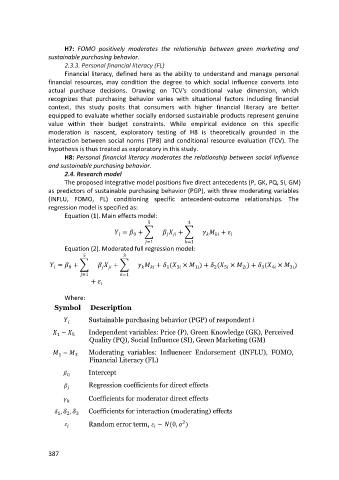
                        The proposed integrative model positions five direct antecedents (P, GK, PQ, SI, GM)
                  as predictors of sustainable purchasing behavior (PGP), with three moderating variables
                  (INFLU, FOMO, FL) conditioning specific antecedent-outcome relationships. The
                  regression model is specified as:
                        Equation (1). Main effects model:
                                                     5             3
                                           =   +               +             +


                                                0


                                                     =1            =1
                        Equation (2). Moderated full regression model:
                              5             3
                     =   +              +             +   (  ×   ) +   (  ×   ) +   (  ×   )
                         0                                  1  3     1      2   5     2      3  4      3
                              =1            =1
                                 +
                        Where:
                    Symbol       Description


                                Sustainable purchasing behavior (PGP) of respondent
                      –   5     Independent variables: Price (P), Green Knowledge (GK), Perceived
                     1
                                Quality (PQ), Social Influence (SI), Green Marketing (GM)

                      –         Moderating variables: Influencer Endorsement (INFLU), FOMO,
                      1    3
                                Financial Literacy (FL)
                                Intercept
                         0
                                Regression coefficients for direct effects


                                Coefficients for moderator direct effects

                      ,   ,   3  Coefficients for interaction (moderating) effects
                     1
                         2
                                                                 2
                                Random error term,   ∼  (0,   )


                  387

