


Page 389 - ISC PROCEEDINGS 21.4
P. 389
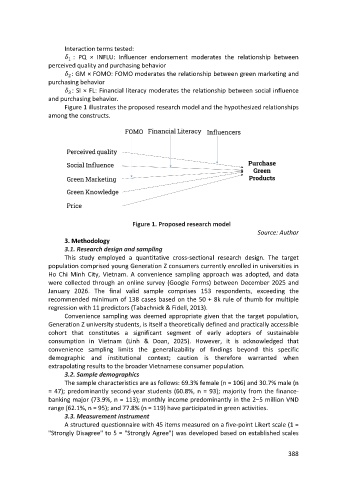
Interaction terms tested:
                          : PQ × INFLU: Influencer endorsement moderates the relationship between
                         1
                  perceived quality and purchasing behavior
                          : GM × FOMO: FOMO moderates the relationship between green marketing and
                         2
                  purchasing behavior
                          : SI × FL: Financial literacy moderates the relationship between social influence
                         3
                  and purchasing behavior.
                        Figure 1 illustrates the proposed research model and the hypothesized relationships
                  among the constructs.


                                                Figure 1. Proposed research model
                                                                                            Source: Author
                        3. Methodology
                        3.1. Research design and sampling
                        This study employed a quantitative cross‑sectional research design. The target
                  population comprised young Generation Z consumers currently enrolled in universities in
                  Ho Chi Minh City, Vietnam. A convenience sampling approach was adopted, and data
                  were collected through an online survey (Google Forms) between December 2025 and
                  January 2026. The final valid sample comprises 153 respondents, exceeding the
                  recommended minimum of 138 cases based on the 50 + 8k rule of thumb for multiple
                  regression with 11 predictors (Tabachnick & Fidell, 2013).
                        Convenience sampling was deemed appropriate given that the target population,
                  Generation Z university students, is itself a theoretically defined and practically accessible
                  cohort that constitutes a significant segment of early adopters of sustainable
                  consumption in Vietnam (Linh & Doan, 2025). However, it is acknowledged that
                  convenience sampling limits the generalizability of findings beyond this specific
                  demographic and institutional context; caution is therefore warranted when
                  extrapolating results to the broader Vietnamese consumer population.
                        3.2. Sample demographics
                        The sample characteristics are as follows: 69.3% female (n = 106) and 30.7% male (n
                  = 47); predominantly second-year students (60.8%, n = 93); majority from the finance-
                  banking major (73.9%, n = 113); monthly income predominantly in the 2–5 million VND
                  range (62.1%, n = 95); and 77.8% (n = 119) have participated in green activities.
                        3.3. Measurement instrument
                        A structured questionnaire with 45 items measured on a five-point Likert scale (1 =
                  "Strongly Disagree" to 5 = "Strongly Agree") was developed based on established scales


                                                                                                      388

