


Page 386 - ISC PROCEEDINGS 21.4
P. 386
choice. By integrating these frameworks, the model captures both rational decision-
                  making processes and the value-driven nature of sustainable consumption.
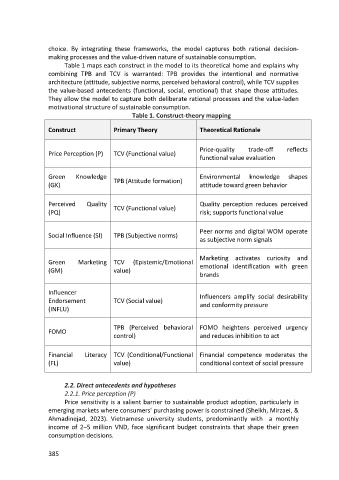
                        Table 1 maps each construct in the model to its theoretical home and explains why
                  combining TPB and TCV is warranted: TPB provides the intentional and normative
                  architecture (attitude, subjective norms, perceived behavioral control), while TCV supplies
                  the value-based antecedents (functional, social, emotional) that shape those attitudes.
                  They allow the model to capture both deliberate rational processes and the value-laden
                  motivational structure of sustainable consumption.
                                               Table 1. Construct-theory mapping

                  Construct              Primary Theory                Theoretical Rationale


                                                                       Price-quality    trade-off     reflects
                  Price Perception (P)   TCV (Functional value)
                                                                       functional value evaluation


                  Green     Knowledge                                  Environmental     knowledge    shapes
                  (GK)                   TPB (Attitude formation)      attitude toward green behavior


                  Perceived     Quality  TCV (Functional value)        Quality perception reduces perceived
                  (PQ)                                                 risk; supports functional value


                                                                       Peer norms and digital WOM operate
                  Social Influence (SI)  TPB (Subjective norms)
                                                                       as subjective norm signals


                                                                       Marketing activates curiosity and
                  Green     Marketing    TCV    (Epistemic/Emotional   emotional identification with green
                  (GM)                   value)
                                                                       brands


                  Influencer
                  Endorsement            TCV (Social value)            Influencers amplify social desirability
                                                                       and conformity pressure
                  (INFLU)


                                         TPB (Perceived behavioral     FOMO heightens perceived urgency
                  FOMO
                                         control)                      and reduces inhibition to act


                  Financial    Literacy  TCV (Conditional/Functional   Financial competence moderates the
                  (FL)                   value)                        conditional context of social pressure


                        2.2. Direct antecedents and hypotheses
                        2.2.1. Price perception (P)
                        Price sensitivity is a salient barrier to sustainable product adoption, particularly in
                  emerging markets where consumers' purchasing power is constrained (Sheikh, Mirzaei, &
                  Ahmadinejad, 2023). Vietnamese university students, predominantly with a monthly
                  income of 2–5 million VND, face significant budget constraints that shape their green
                  consumption decisions.


                  385

