


Page 390 - ISC PROCEEDINGS 21.4
P. 390
from prior literature. The dependent variable, sustainable purchasing behavior (Perchase
                  Green Products - PGP), was measured with 5 items adapted from Chan and Lau (2001)
                  and Ramayah, Lee, and Mohamad (2010). Five independent variables (Price, Green
                  Knowledge, Perceived Quality, Social Influence, Green Marketing) and three moderating
                  variables (Influencer Endorsement, FOMO, Financial Literacy) were each measured with 5
                  items.
                        All items were originally developed or sourced in English and translated into
                  Vietnamese using a forward-backward translation procedure: items were first translated
                  into Vietnamese by a bilingual research team member, then independently back-
                  translated into English by a second bilingual translator, with discrepancies resolved
                  through discussion (Brislin, 1970). A pretest was conducted with 15 university students
                  and two faculty reviewers to assess item clarity and cultural appropriateness; minor
                  wording adjustments were made before final deployment.
                        3.4. Analytical procedures
                        Data analysis followed a systematic four-stage process using SPSS: (1) Descriptive
                  statistics for sample profiling; (2) Reliability testing via Cronbach's Alpha (threshold α ≥
                  0.70); (3) Exploratory Factor Analysis (EFA) with KMO ≥ 0.50, Bartlett's test p < 0.05,
                  Eigenvalue ≥ 1.0, factor loadings ≥ 0.45, and total variance extracted ≥ 50%; (4)
                  Hierarchical moderated multiple regression with multicollinearity diagnostics (VIF < 10),
                  residual normality testing (Kolmogorov-Smirnov), homoscedasticity assessment, and
                  autocorrelation testing (Durbin-Watson). (5) To assess common method bias (CMB),
                  Harman's single-factor test was performed by entering all 45 items into an unrotated
                  principal component analysis (Podsakoff, MacKenzie, Lee, & Podsakoff, 2003). The first
                  unrotated factor accounted for 34.42% of the total variance, which is well below the
                  conventional 50% threshold, indicating that common method variance is unlikely to
                  constitute a serious threat to the validity of the findings.
                        4. Results
                        4.1. Reliability analysis
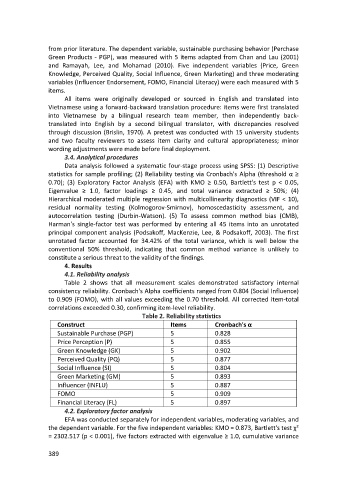
                        Table 2 shows that all measurement scales demonstrated satisfactory internal
                  consistency reliability. Cronbach's Alpha coefficients ranged from 0.804 (Social Influence)
                  to 0.909 (FOMO), with all values exceeding the 0.70 threshold. All corrected item-total
                  correlations exceeded 0.30, confirming item-level reliability.
                                                   Table 2. Reliability statistics
                     Construct                               Items           Cronbach's α
                     Sustainable Purchase (PGP)              5               0.828
                     Price Perception (P)                    5               0.855
                     Green Knowledge (GK)                    5               0.902
                     Perceived Quality (PQ)                  5               0.877
                     Social Influence (SI)                   5               0.804
                     Green Marketing (GM)                    5               0.893
                     Influencer (INFLU)                      5               0.887
                     FOMO                                    5               0.909
                     Financial Literacy (FL)                 5               0.897
                        4.2. Exploratory factor analysis
                        EFA was conducted separately for independent variables, moderating variables, and
                  the dependent variable. For the five independent variables: KMO = 0.873, Bartlett's test χ²
                  = 2302.517 (p < 0.001), five factors extracted with eigenvalue ≥ 1.0, cumulative variance


                  389

