


Page 392 - ISC PROCEEDINGS 21.4
P. 392
regression (β = 0.122, p < 0.001). This pattern is consistent with the phenomenon
                  of suppression, in which a variable's unique predictive contribution to the outcome is
                  masked in bivariate analysis due to shared variance with other predictors, particularly
                  Green Marketing (GM) and Influencer Endorsement (INFLU), with which SI is positively
                  correlated. Once these correlated variables are entered into the regression equation and
                  their shared variance is statistically controlled, SI's independent contribution to
                  sustainable purchasing behavior becomes statistically discernible (Paulhus et al., 2004).
                  This finding does not invalidate H4 but underscores the importance of multivariate over
                  bivariate inference in models with correlated predictors.
                        4.5. Hypothesis testing summary
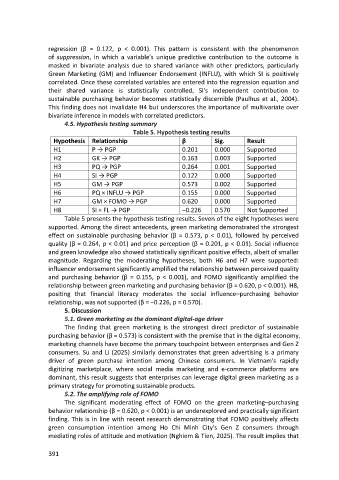
                                                Table 5. Hypothesis testing results
                    Hypothesis   Relationship                    β          Sig.        Result
                    H1           P → PGP                         0.201      0.000       Supported
                    H2           GK → PGP                        0.163      0.003       Supported
                    H3           PQ → PGP                        0.264      0.001       Supported
                    H4           SI → PGP                        0.122      0.000       Supported
                    H5           GM → PGP                        0.573      0.002       Supported
                    H6           PQ × INFLU → PGP                0.155      0.000       Supported
                    H7           GM × FOMO → PGP                 0.620      0.000       Supported
                    H8           SI × FL → PGP                   −0.226     0.570       Not Supported
                        Table 5 presents the hypothesis testing results. Seven of the eight hypotheses were
                  supported. Among the direct antecedents, green marketing demonstrated the strongest
                  effect on sustainable purchasing behavior (β = 0.573, p < 0.01), followed by perceived
                  quality (β = 0.264, p < 0.01) and price perception (β = 0.201, p < 0.01). Social influence
                  and green knowledge also showed statistically significant positive effects, albeit of smaller
                  magnitude. Regarding the moderating hypotheses, both H6 and H7 were supported:
                  influencer endorsement significantly amplified the relationship between perceived quality
                  and purchasing behavior (β = 0.155, p < 0.001), and FOMO significantly amplified the
                  relationship between green marketing and purchasing behavior (β = 0.620, p < 0.001). H8,
                  positing that financial literacy moderates the social influence–purchasing behavior
                  relationship, was not supported (β = −0.226, p = 0.570).
                        5. Discussion
                        5.1. Green marketing as the dominant digital-age driver
                        The finding that green marketing is the strongest direct predictor of sustainable
                  purchasing behavior (β = 0.573) is consistent with the premise that in the digital economy,
                  marketing channels have become the primary touchpoint between enterprises and Gen Z
                  consumers. Su and Li (2025) similarly demonstrates that green advertising is a primary
                  driver of green purchase intention among Chinese consumers. In Vietnam's rapidly
                  digitizing marketplace, where social media marketing and e-commerce platforms are
                  dominant, this result suggests that enterprises can leverage digital green marketing as a
                  primary strategy for promoting sustainable products.
                        5.2. The amplifying role of FOMO
                        The significant moderating effect of FOMO on the green marketing–purchasing
                  behavior relationship (β = 0.620, p < 0.001) is an underexplored and practically significant
                  finding. This is in line with recent research demonstrating that FOMO positively affects
                  green consumption intention among Ho Chi Minh City's Gen Z consumers through
                  mediating roles of attitude and motivation (Nghiem & Tien, 2025). The result implies that


                  391

