


Page 363 - ISC PROCEEDINGS 21.4
P. 363
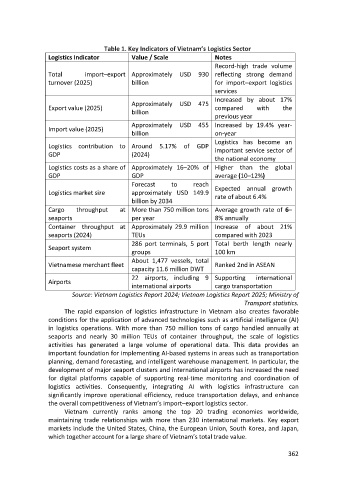
Table 1. Key Indicators of Vietnam’s Logistics Sector
                  Logistics Indicator          Value / Scale                 Notes
                                                                             Record-high trade volume
                  Total        import–export Approximately      USD    930 reflecting strong demand
                  turnover (2025)              billion                       for import–export logistics
                                                                             services
                                                                             Increased by about 17%
                                               Approximately    USD    475
                  Export value (2025)                                        compared      with     the
                                               billion
                                                                             previous year
                                               Approximately    USD    455 Increased by 19.4% year-
                  Import value (2025)
                                               billion                       on-year
                                                                             Logistics has become an
                  Logistics contribution to Around       5.17%    of  GDP    important service sector of
                  GDP                          (2024)
                                                                             the national economy
                  Logistics costs as a share of Approximately 16–20% of Higher than the global
                  GDP                          GDP                           average (10–12%)
                                               Forecast      to      reach
                  Logistics market size        approximately USD 149.9       Expected annual growth
                                               billion by 2034               rate of about 6.4%
                  Cargo     throughput     at More than 750 million tons Average growth rate of 6–
                  seaports                     per year                      8% annually
                  Container throughput at Approximately 29.9 million Increase of about 21%
                  seaports (2024)              TEUs                          compared with 2023
                                               286 port terminals, 5 port Total berth length nearly
                  Seaport system
                                               groups                        100 km
                                               About 1,477 vessels, total
                  Vietnamese merchant fleet                                  Ranked 2nd in ASEAN
                                               capacity 11.6 million DWT
                                               22 airports, including 9 Supporting         international
                  Airports
                                               international airports        cargo transportation
                          Source: Vietnam Logistics Report 2024; Vietnam Logistics Report 2025; Ministry of
                                                                                       Transport statistics.
                        The rapid expansion of logistics infrastructure in Vietnam also creates favorable
                  conditions for the application of advanced technologies such as artificial intelligence (AI)
                  in logistics operations. With more than 750 million tons of cargo handled annually at
                  seaports and nearly 30 million TEUs of container throughput, the scale of logistics
                  activities has generated a large volume of operational data. This data provides an
                  important foundation for implementing AI-based systems in areas such as transportation
                  planning, demand forecasting, and intelligent warehouse management. In particular, the
                  development of major seaport clusters and international airports has increased the need
                  for digital platforms capable of supporting real-time monitoring and coordination of
                  logistics activities. Consequently, integrating AI with logistics infrastructure can
                  significantly improve operational efficiency, reduce transportation delays, and enhance
                  the overall competitiveness of Vietnam’s import–export logistics sector.
                        Vietnam currently ranks among the top 20 trading economies worldwide,
                  maintaining trade relationships with more than 230 international markets. Key export
                  markets include the United States, China, the European Union, South Korea, and Japan,
                  which together account for a large share of Vietnam’s total trade value.

                                                                                                      362

