


Page 364 - ISC PROCEEDINGS 21.4
P. 364
The expansion of major free trade agreements such as CPTPP, EVFTA, and RCEP has
                  further stimulated demand for advanced logistics services, particularly in areas such as
                  international transportation, cross-border warehousing, and global supply chain
                  management.
                        However, logistics costs in Vietnam remain relatively high, accounting for
                  approximately 16–20 percent of GDP, while in developed economies such as the United
                  States and European countries this figure typically ranges between 8–12 percent. This
                  indicates that Vietnam still has significant potential to improve logistics efficiency through
                  the adoption of advanced technologies such as artificial intelligence, big data analytics,
                  and the Internet of Things.
                        3.2. Logistics infrastructure supporting import–export activities
                        Logistics infrastructure plays a fundamental role in supporting import–export
                  activities. Vietnam currently possesses a relatively diverse transportation system
                  consisting of seaports, airports, road networks, and railways that facilitate international
                  trade.
                        3.2.1. Seaport system
                        According to statistics from the Ministry of Transport, Vietnam currently has more
                  than 290 port terminals belonging to 34 seaports, with a total cargo handling capacity
                  exceeding 750 million tons per year [2]. Major seaports such as Hai Phong, Cai Mep – Thi
                  Vai, and Ho Chi Minh City ports play a critical role in connecting Vietnam with global
                  maritime shipping routes.
                        In particular, the Cai Mep – Thị Vai port complex is one of the largest deep-water
                  ports in Southeast Asia. It is capable of accommodating large container vessels and
                  establishing direct connections with major shipping routes across the Pacific Ocean and
                  Europe. As a result, the transportation time for Vietnamese exports has been significantly
                  reduced, while transshipment costs through intermediate ports have also decreased.
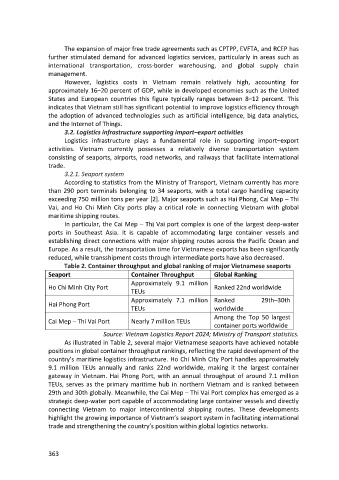
                        Table 2. Container throughput and global ranking of major Vietnamese seaports
                  Seaport                      Container Throughput         Global Ranking
                                               Approximately 9.1 million
                  Ho Chi Minh City Port                                     Ranked 22nd worldwide
                                               TEUs
                                               Approximately 7.1 million Ranked              29th–30th
                  Hai Phong Port
                                               TEUs                         worldwide
                                                                            Among the Top 50 largest
                  Cai Mep – Thi Vai Port       Nearly 7 million TEUs
                                                                            container ports worldwide
                                     Source: Vietnam Logistics Report 2024; Ministry of Transport statistics.
                        As illustrated in Table 2, several major Vietnamese seaports have achieved notable
                  positions in global container throughput rankings, reflecting the rapid development of the
                  country’s maritime logistics infrastructure. Ho Chi Minh City Port handles approximately
                  9.1 million TEUs annually and ranks 22nd worldwide, making it the largest container
                  gateway in Vietnam. Hai Phong Port, with an annual throughput of around 7.1 million
                  TEUs, serves as the primary maritime hub in northern Vietnam and is ranked between
                  29th and 30th globally. Meanwhile, the Cai Mep – Thi Vai Port complex has emerged as a
                  strategic deep-water port capable of accommodating large container vessels and directly
                  connecting Vietnam to major intercontinental shipping routes. These developments
                  highlight the growing importance of Vietnam’s seaport system in facilitating international
                  trade and strengthening the country’s position within global logistics networks.


                  363

