


Page 329 - ISC PROCEEDINGS 21.4
P. 329
institutional environment has not yet become a sufficiently strong enabling force in day-
                  to-day digital transformation processes.
                        From the TOE perspective, the environmental context is therefore characterized by
                  asymmetry: pressure is high, but support is weaker. Competition and customer
                  expectations act as strong external push factors, while institutional assistance does not
                  yet appear equally effective in reducing risks, costs and uncertainty for SMEs. This
                  asymmetry has important implications. When digital transformation is driven mainly by
                  market pressure, firms may prioritize short-term operational responses aimed at survival
                  and competitiveness. By contrast, when digital transformation is supported by a stronger
                  institutional ecosystem, firms are more likely to invest in deeper and more strategic forms
                  of transformation. The results of this study suggest that Vietnamese SMEs are currently
                  operating closer to the first scenario.
                        This also helps explain why digital transformation may produce uneven
                  sustainability outcomes. If the dominant external driver is competition rather than
                  coordinated policy support, SMEs are more likely to focus first on efficiency and market
                  expansion, while social and environmental integration may remain secondary.
                        3.3. Relationship between digital transformation and sustainable development
                  outcomes


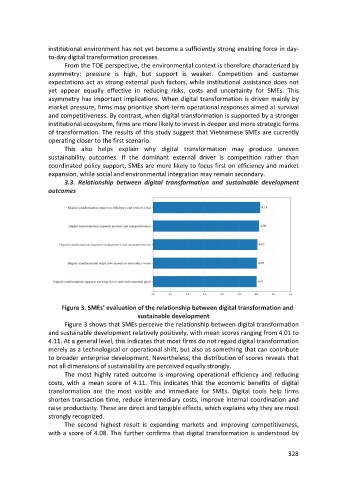
                       Figure 3. SMEs’ evaluation of the relationship between digital transformation and
                                                 sustainable development
                        Figure 3 shows that SMEs perceive the relationship between digital transformation
                  and sustainable development relatively positively, with mean scores ranging from 4.01 to
                  4.11. At a general level, this indicates that most firms do not regard digital transformation
                  merely as a technological or operational shift, but also as something that can contribute
                  to broader enterprise development. Nevertheless, the distribution of scores reveals that
                  not all dimensions of sustainability are perceived equally strongly.
                        The most highly rated outcome is improving operational efficiency and reducing
                  costs, with a mean score of 4.11. This indicates that the economic benefits of digital
                  transformation are the most visible and immediate for SMEs. Digital tools help firms
                  shorten transaction time, reduce intermediary costs, improve internal coordination and
                  raise productivity. These are direct and tangible effects, which explains why they are most
                  strongly recognized.
                        The second highest result is expanding markets and improving competitiveness,
                  with a score of 4.08. This further confirms that digital transformation is understood by


                                                                                                      328

