


Page 328 - ISC PROCEEDINGS 21.4
P. 328
weaker at the operational-capability level. This is an important distinction because it
                  implies that digital transformation in many SMEs may remain dependent on leadership
                  vision and short-term initiatives unless firms strengthen their resource base and
                  implementation capacity.
                        3.2. Environmental factors affecting digital transformation in SMEs


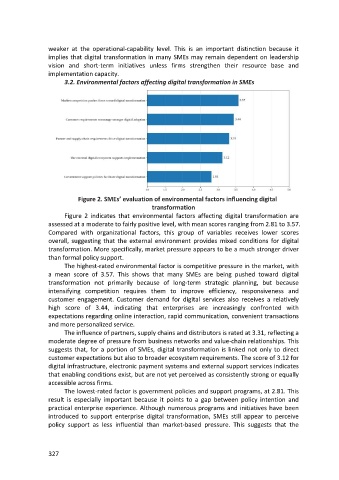
                            Figure 2. SMEs’ evaluation of environmental factors influencing digital
                                                      transformation
                        Figure 2 indicates that environmental factors affecting digital transformation are
                  assessed at a moderate to fairly positive level, with mean scores ranging from 2.81 to 3.57.
                  Compared with organizational factors, this group of variables receives lower scores
                  overall, suggesting that the external environment provides mixed conditions for digital
                  transformation. More specifically, market pressure appears to be a much stronger driver
                  than formal policy support.
                        The highest-rated environmental factor is competitive pressure in the market, with
                  a mean score of 3.57. This shows that many SMEs are being pushed toward digital
                  transformation not primarily because of long-term strategic planning, but because
                  intensifying competition requires them to improve efficiency, responsiveness and
                  customer engagement. Customer demand for digital services also receives a relatively
                  high score of 3.44, indicating that enterprises are increasingly confronted with
                  expectations regarding online interaction, rapid communication, convenient transactions
                  and more personalized service.
                        The influence of partners, supply chains and distributors is rated at 3.31, reflecting a
                  moderate degree of pressure from business networks and value-chain relationships. This
                  suggests that, for a portion of SMEs, digital transformation is linked not only to direct
                  customer expectations but also to broader ecosystem requirements. The score of 3.12 for
                  digital infrastructure, electronic payment systems and external support services indicates
                  that enabling conditions exist, but are not yet perceived as consistently strong or equally
                  accessible across firms.
                        The lowest-rated factor is government policies and support programs, at 2.81. This
                  result is especially important because it points to a gap between policy intention and
                  practical enterprise experience. Although numerous programs and initiatives have been
                  introduced to support enterprise digital transformation, SMEs still appear to perceive
                  policy support as less influential than market-based pressure. This suggests that the


                  327

