


Page 27 - HT Luật
P. 27
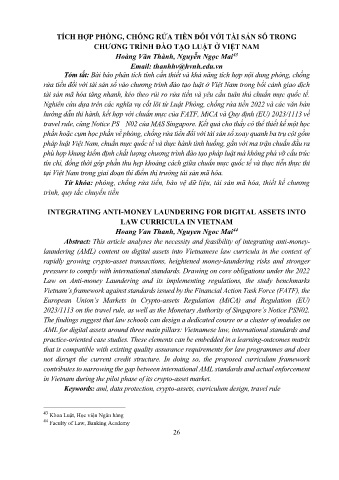
TÍCH HỢP PHÒNG, CHỐNG RỬA TIỀN ĐỐI VỚI TÀI SẢN SỐ TRONG
                                  CHƯƠNG TRÌNH ĐÀO TẠO LUẬT Ở VIỆT NAM
                                                                                   43
                                          Hoàng Văn Thành, Nguyễn Ngọc Mai
                                               Email: thanhhv@hvnh.edu.vn
                        Tóm tắt: Bài báo phân tích tính cần thiết và khả năng tích hợp nội dung phòng, chống
                rửa tiền đối với tài sản số vào chương trình đào tạo luật ở Việt Nam trong bối cảnh giao dịch
                tài sản mã hóa tăng nhanh, kéo theo rủi ro rửa tiền và yêu cầu tuân thủ chuẩn mực quốc tế.
                Nghiên cứu dựa trên các nghĩa vụ cốt lõi từ Luật Phòng, chống rửa tiền 2022 và các văn bản
                hướng dẫn thi hành, kết hợp với chuẩn mực của FATF, MiCA và Quy định (EU) 2023/1113 về
                travel rule, cùng Notice PS  N02 của MAS Singapore. Kết quả cho thấy có thể thiết kế một học
                phần hoặc cụm học phần về phòng, chống rửa tiền đối với tài sản số xoay quanh ba trụ cột gồm
                pháp luật Việt Nam, chuẩn mực quốc tế và thực hành tình huống, gắn với ma trận chuẩn đầu ra

                phù hợp khung kiểm định chất lượng chương trình đào tạo pháp luật mà không phá vỡ cấu trúc
                tín chỉ, đồng thời góp phần thu hẹp khoảng cách giữa chuẩn mực quốc tế và thực tiễn thực thi
                tại Việt Nam trong giai đoạn thí điểm thị trường tài sản mã hóa.
                        Từ khóa: phòng, chống rửa tiền, bảo vệ dữ liệu, tài sản mã hóa, thiết kế chương
                trình, quy tắc chuyển tiền


                  INTEGRATING ANTI-MONEY LAUNDERING FOR DIGITAL ASSETS INTO
                                           LAW CURRICULA IN VIETNAM
                                                                                   44
                                          Hoang Van Thanh, Nguyen Ngoc Mai
                        Abstract: This article analyses the necessity and feasibility of integrating anti-money-
                laundering (AML) content on digital assets into Vietnamese law curricula in the context of
                rapidly growing crypto-asset transactions, heightened money-laundering risks and stronger
                pressure to comply with international standards. Drawing on core obligations under the 2022

                Law  on  Anti-money  Laundering  and  its  implementing  regulations,  the  study  benchmarks
                Vietnam’s framework against standards issued by the Financial Action Task Force (FATF), the
                European  Union’s  Markets  in  Crypto-assets  Regulation  (MiCA)  and  Regulation  (EU)
                2023/1113 on the travel rule, as well as the Monetary Authority of Singapore’s Notice PSN02.
                The findings suggest that law schools can design a dedicated course or a cluster of modules on
                AML for digital assets around three main pillars: Vietnamese law, international standards and

                practice-oriented case studies. These elements can be embedded in a learning-outcomes matrix
                that is compatible with existing quality assurance requirements for law programmes and does
                not  disrupt  the  current  credit  structure.  In  doing  so,  the  proposed  curriculum  framework
                contributes to narrowing the gap between international AML standards and actual enforcement
                in Vietnam during the pilot phase of its crypto-asset market.
                        Keywords: aml, data protection, crypto-assets, curriculum design, travel rule


                43
                   Khoa Luật, Học viện Ngân hàng
                44  Faculty of Law, Banking Academy
                                                              26

