


Page 821 - ISC PROCEEDINGS 21.4
P. 821
3. Methodologies of research
                        3.1. Sampling and data acquisition
                        Utilising a synthesis of prior research, the authors created a preliminary survey
                  questionnaire and executed a pilot survey with 50 participants (n = 50) to assess the clarity
                  and appropriateness of the observed factors in the scale. The pilot survey results were
                  utilised to modify and enhance the official questionnaire prior to executing a large-scale
                  survey. The research employed a convenience sample strategy, targeting accounting
                  lecturers and third- and fourth-year accounting students at institutions. These entities are
                  directly engaged in the educational process and are thus equipped to assess the degree of
                  innovation in accounting pedagogy. The poll yielded 295 valid replies, which were utilised for
                  the subsequent analytical procedures.
                        3.2. Research methodology
                        The study employed a mixed-methods approach, integrating qualitative and
                  quantitative techniques. Qualitative research encompasses a literature review and analysis
                  of prior studies to ascertain elements that may affect teaching innovation in accounting
                  education, so establishing a foundation for presenting a model and research hypotheses.
                  Consequently, quantitative research was undertaken to evaluate the proposed model and
                  hypotheses. Data for the research was gathered via an online survey targeting accounting
                  lecturers and third- and fourth-year accounting students at institutions from December 2025
                  to January 2026. The survey instrument was constructed with a 5-point Likert scale. Prior to
                  administering the official survey, a pilot survey was executed including 50 lecturers and
                  professionals in accounting to evaluate and refine the questionnaire content. The official
                  survey produced 295 legitimate replies, which were utilised for data analysis. The data were
                  analysed using SPSS 26 software employing techniques like descriptive statistics, scale
                  reliability assessment, and regression analysis to evaluate the correlations among variables
                  in the research model.
                        4. Research findings
                        4.1. Evaluating the reliability of the scales
                        The reliability of the scales was assessed using Cronbach's Alpha coefficient. The
                  analytical results indicated that the majority of the observed variables satisfied the criteria
                  (Cronbach's Alpha coefficient ≥ 0.6 and item-total correlation coefficient ≥ 0.3). Following
                  Cronbach's Alpha assessment, the study model kept 6 independent variables and 1
                  dependent variable, including 22 observed variables, for exploratory factor analysis (EFA).
                  The independent variables were analysed concurrently, whilst the dependent variable
                  "Innovation in accounting teaching methods" was examined independently. The
                  independent variable values were evaluated using fundamental statistical techniques,
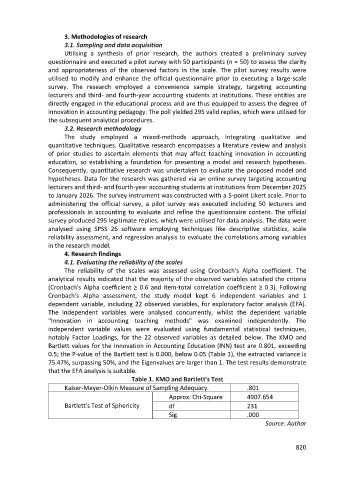
                  notably Factor Loadings, for the 22 observed variables as detailed below. The KMO and
                  Bartlett values for the Innovation in Accounting Education (INN) test are 0.801, exceeding
                  0.5; the P-value of the Bartlett test is 0.000, below 0.05 (Table 1), the extracted variance is
                  75.47%, surpassing 50%, and the Eigenvalues are larger than 1. The test results demonstrate
                  that the EFA analysis is suitable.
                                               Table 1. KMO and Bartlett's Test
                        Kaiser-Meyer-Olkin Measure of Sampling Adequacy.                .801
                                                            Approx. Chi-Square          4907.654
                        Bartlett's Test of Sphericity       df                          231
                                                            Sig.                        .000
                                                                                              Source: Author


                                                                                                         820

