


Page 823 - ISC PROCEEDINGS 21.4
P. 823
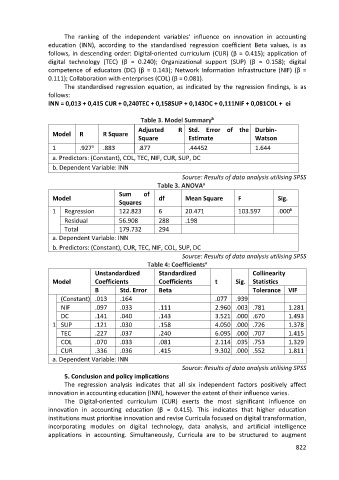
The ranking of the independent variables' influence on innovation in accounting
                  education (INN), according to the standardised regression coefficient Beta values, is as
                  follows, in descending order: Digital-oriented curriculum (CUR) (β = 0.415); application of
                  digital technology (TEC) (β = 0.240); Organizational support (SUP) (β = 0.158); digital
                  competence of educators (DC) (β = 0.143); Network Information Infrastructure (NIF) (β =
                  0.111); Collaboration with enterprises (COL) (β = 0.081).
                        The standardised regression equation, as indicated by the regression findings, is as
                  follows:
                  INN = 0,013 + 0,415 CUR + 0,240TEC + 0,158SUP + 0,143DC + 0,111NIF + 0,081COL + ei

                                                  Table 3. Model Summary   b
                                                  Adjusted      R Std. Error of the Durbin-
                   Model     R       R Square
                                                  Square           Estimate                Watson
                   1         .927 a  .883         .877             .44452                  1.644

                   a. Predictors: (Constant), COL, TEC, NIF, CUR, SUP, DC
                   b. Dependent Variable: INN
                                                                 Source: Results of data analysis utilising SPSS
                                                        Table 3. ANOVA  a
                                           Sum      of
                   Model                                 df       Mean Square        F             Sig.
                                           Squares
                   1    Regression         122.823       6        20.471             103.597       .000 b
                        Residual           56.908        288      .198
                        Total              179.732       294
                   a. Dependent Variable: INN
                   b. Predictors: (Constant), CUR, TEC, NIF, COL, SUP, DC
                                                                 Source: Results of data analysis utilising SPSS
                                                     Table 4: Coefficients a
                                  Unstandardized         Standardized                     Collinearity
                   Model          Coefficients           Coefficients        t      Sig.  Statistics
                                  B        Std. Error    Beta                             Tolerance   VIF
                      (Constant) .013      .164                              .077   .939
                      NIF         .097     .033          .111                2.960 .003 .781          1.281
                      DC          .141     .040          .143                3.521 .000 .670          1.493
                   1 SUP          .121     .030          .158                4.050 .000 .726          1.378
                      TEC         .227     .037          .240                6.095 .000 .707          1.415
                      COL         .070     .033          .081                2.114 .035 .753          1.329
                      CUR         .336     .036          .415                9.302 .000 .552          1.811
                   a. Dependent Variable: INN
                                                                 Source: Results of data analysis utilising SPSS
                        5. Conclusion and policy implications
                        The regression analysis indicates that all six independent factors positively affect
                  innovation in accounting education (INN), however the extent of their influence varies.
                        The Digital-oriented curriculum (CUR) exerts the most significant influence on
                  innovation in accounting education (β = 0.415). This indicates that higher education
                  institutions must prioritise innovation and revise Curricula focused on digital transformation,
                  incorporating modules on digital technology, data analysis, and artificial intelligence
                  applications in accounting. Simultaneously, Curricula are to be structured to augment

                                                                                                         822

