


Page 820 - ISC PROCEEDINGS 21.4
P. 820
course imparts specialised knowledge while cultivating abilities in accounting software,
                  information systems, and data analysis. Incorporating technology into curricula is thought to
                  foster innovation in pedagogical approaches, broaden flexible learning modalities, and
                  improve involvement with professional practice (Bond et al., 2018; OECD, 2025; Redecker,
                  2017). Consequently, the research posits the hypothesis:
                        H3: Digital-oriented curriculum enhances pedagogical innovation.
                        Organizational support
                        Barney's (1991) perspective posits that school rules and resources will foster an
                  environment conducive to lecturers implementing innovative teaching methods and
                  incorporating technology into the educational process. This support is evidenced by policies
                  that promote innovation in pedagogical approaches, facilitate curricula to augment
                  lecturers' technical proficiency, and allocate funding for instructional activities. The study
                  posits the hypothesis:
                        H4: Organizational support enhances pedagogical innovation
                        Collaboration with enterprises
                        This is seen as a significant factor in fostering educational innovation in higher
                  education. This collaboration enables training institutions to align the curriculum with the
                  actual demands of the labour market by engaging in curriculum creation, facilitating
                  internships, and exchanging professional expertise from enterprises. In accounting
                  education, corporate engagement facilitates the enhancement of processes, technologies,
                  and professional competencies, consequently fostering innovation in content and
                  pedagogical approaches to elevate training quality (OECD, 2025). The study posits the
                  hypothesis:
                        H5: Collaboration with enterprises in accounting education enhances pedagogical
                  innovation.
                        Application of digital technology
                        The utilisation of online learning platforms, learning management systems (LMS),
                  accounting software, and digital technologies improves engagement, broadens flexible
                  learning modalities, and aids learners in acquiring knowledge more efficiently. In accounting
                  education, the incorporation of digital technologies into instructional activities enhances the
                  linkage between theoretical concepts and professional practice, hence elevating the quality
                  of training within the digital economy (Davis, 1989; OECD, 2025). The study posits the
                  hypothesis:
                        H6: The extent of Application of Digital Technology in accounting education favourably
                  impacts pedagogical innovation.
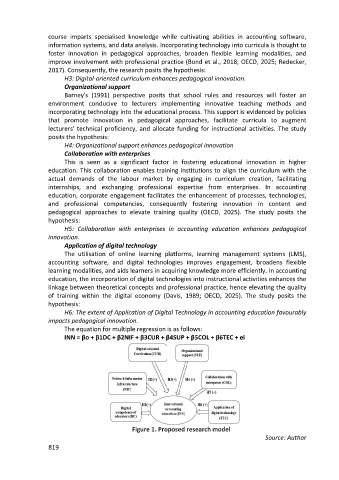
                        The equation for multiple regression is as follows:
                        INN = βo + β1DC + β2NIF + β3CUR + β4SUP + β5COL + β6TEC + ei


                                               Figure 1. Proposed research model
                                                                                              Source: Author
                  819

