


Page 727 - ISC PROCEEDINGS 21.4
P. 727
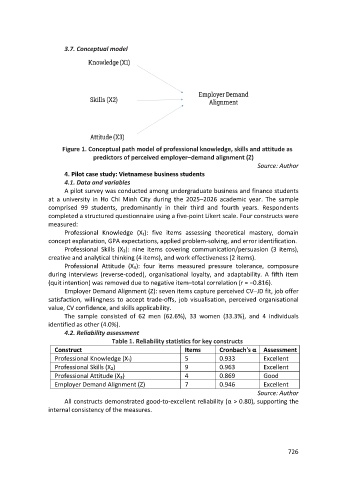
3.7. Conceptual model


                       Figure 1. Conceptual path model of professional knowledge, skills and attitude as
                                  predictors of perceived employer–demand alignment (Z)
                                                                                           Source: Author
                        4. Pilot case study: Vietnamese business students
                        4.1. Data and variables
                        A pilot survey was conducted among undergraduate business and finance students
                  at a university in Ho Chi Minh City during the 2025–2026 academic year. The sample
                  comprised 99 students, predominantly in their third and fourth years. Respondents
                  completed a structured questionnaire using a five-point Likert scale. Four constructs were
                  measured:
                        Professional Knowledge (X₁): five items assessing theoretical mastery, domain
                  concept explanation, GPA expectations, applied problem-solving, and error identification.
                        Professional Skills (X₂): nine items covering communication/persuasion (3 items),
                  creative and analytical thinking (4 items), and work effectiveness (2 items).
                        Professional Attitude (X₃): four items measured pressure tolerance, composure
                  during interviews (reverse-coded), organisational loyalty, and adaptability. A fifth item
                  (quit intention) was removed due to negative item–total correlation (r = −0.816).
                        Employer Demand Alignment (Z): seven items capture perceived CV–JD fit, job offer
                  satisfaction, willingness to accept trade-offs, job visualisation, perceived organisational
                  value, CV confidence, and skills applicability.
                        The sample consisted of 62 men (62.6%), 33 women (33.3%), and 4 individuals
                  identified as other (4.0%).
                        4.2. Reliability assessment
                                        Table 1. Reliability statistics for key constructs
                    Construct                                     Items       Cronbach's α    Assessment
                    Professional Knowledge (X₁)                   5           0.933           Excellent
                    Professional Skills (X₂)                      9           0.963           Excellent
                    Professional Attitude (X₃)                    4           0.869           Good
                    Employer Demand Alignment (Z)                 7           0.946           Excellent
                                                                                           Source: Author
                        All constructs demonstrated good-to-excellent reliability (α > 0.80), supporting the
                  internal consistency of the measures.


                                                                                                      726

