


Page 335 - ISC PROCEEDINGS 21.4
P. 335
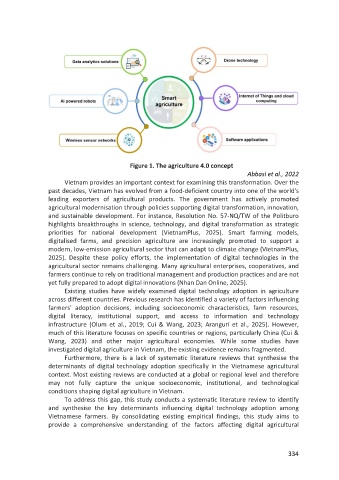
Figure 1. The agriculture 4.0 concept
                                                                                        Abbasi et al., 2022
                        Vietnam provides an important context for examining this transformation. Over the
                  past decades, Vietnam has evolved from a food-deficient country into one of the world's
                  leading exporters of agricultural products. The government has actively promoted
                  agricultural modernisation through policies supporting digital transformation, innovation,
                  and sustainable development. For instance, Resolution No. 57-NQ/TW of the Politburo
                  highlights breakthroughs in science, technology, and digital transformation as strategic
                  priorities for national development (VietnamPlus, 2025). Smart farming models,
                  digitalised farms, and precision agriculture are increasingly promoted to support a
                  modern, low-emission agricultural sector that can adapt to climate change (VietnamPlus,
                  2025). Despite these policy efforts, the implementation of digital technologies in the
                  agricultural sector remains challenging. Many agricultural enterprises, cooperatives, and
                  farmers continue to rely on traditional management and production practices and are not
                  yet fully prepared to adopt digital innovations (Nhan Dan Online, 2025).
                        Existing studies have widely examined digital technology adoption in agriculture
                  across different countries. Previous research has identified a variety of factors influencing
                  farmers’ adoption decisions, including socioeconomic characteristics, farm resources,
                  digital literacy, institutional support, and access to information and technology
                  infrastructure (Olum et al., 2019; Cui & Wang, 2023; Arangurí et al., 2025). However,
                  much of this literature focuses on specific countries or regions, particularly China (Cui &
                  Wang, 2023) and other major agricultural economies. While some studies have
                  investigated digital agriculture in Vietnam, the existing evidence remains fragmented.
                        Furthermore, there is a lack of systematic literature reviews that synthesise the
                  determinants of digital technology adoption specifically in the Vietnamese agricultural
                  context. Most existing reviews are conducted at a global or regional level and therefore
                  may not fully capture the unique socioeconomic, institutional, and technological
                  conditions shaping digital agriculture in Vietnam.
                        To address this gap, this study conducts a systematic literature review to identify
                  and synthesise the key determinants influencing digital technology adoption among
                  Vietnamese farmers. By consolidating existing empirical findings, this study aims to
                  provide a comprehensive understanding of the factors affecting digital agricultural


                                                                                                      334

