


Page 301 - ISC PROCEEDINGS 21.4
P. 301
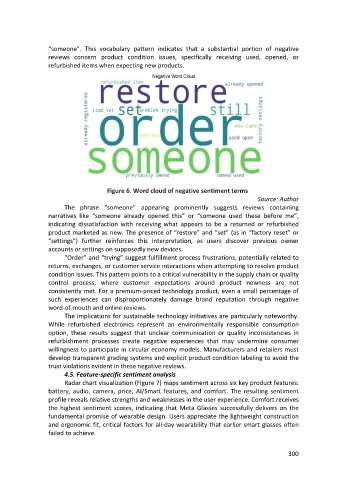
“someone”. This vocabulary pattern indicates that a substantial portion of negative
                  reviews concern product condition issues, specifically receiving used, opened, or
                  refurbished items when expecting new products.


                                       Figure 6. Word cloud of negative sentiment terms
                                                                                            Source: Author
                        The phrase “someone” appearing prominently suggests reviews containing
                  narratives like “someone already opened this” or “someone used these before me”,
                  indicating dissatisfaction with receiving what appears to be a returned or refurbished
                  product marketed as new. The presence of “restore” and “set” (as in “factory reset” or
                  “settings”) further reinforces this interpretation, as users discover previous owner
                  accounts or settings on supposedly new devices.
                        “Order” and “trying” suggest fulfillment process frustrations, potentially related to
                  returns, exchanges, or customer service interactions when attempting to resolve product
                  condition issues. This pattern points to a critical vulnerability in the supply chain or quality
                  control process, where customer expectations around product newness are not
                  consistently met. For a premium-priced technology product, even a small percentage of
                  such experiences can disproportionately damage brand reputation through negative
                  word-of-mouth and online reviews.
                        The implications for sustainable technology initiatives are particularly noteworthy.
                  While refurbished electronics represent an environmentally responsible consumption
                  option, these results suggest that unclear communication or quality inconsistencies in
                  refurbishment processes create negative experiences that may undermine consumer
                  willingness to participate in circular economy models. Manufacturers and retailers must
                  develop transparent grading systems and explicit product condition labeling to avoid the
                  trust violations evident in these negative reviews.
                        4.5. Feature-specific sentiment analysis
                        Radar chart visualization (Figure 7) maps sentiment across six key product features:
                  battery, audio, camera, price, AI/Smart features, and comfort. The resulting sentiment
                  profile reveals relative strengths and weaknesses in the user experience. Comfort receives
                  the highest sentiment scores, indicating that Meta Glasses successfully delivers on the
                  fundamental promise of wearable design. Users appreciate the lightweight construction
                  and ergonomic fit, critical factors for all-day wearability that earlier smart glasses often
                  failed to achieve.


                                                                                                      300

