


Page 299 - ISC PROCEEDINGS 21.4
P. 299
4.2. Temporal trends in user sentiment
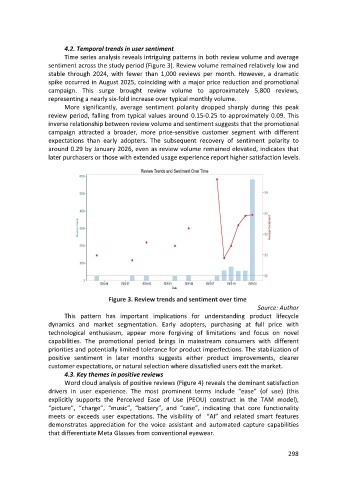
                        Time series analysis reveals intriguing patterns in both review volume and average
                  sentiment across the study period (Figure 3). Review volume remained relatively low and
                  stable through 2024, with fewer than 1,000 reviews per month. However, a dramatic
                  spike occurred in August 2025, coinciding with a major price reduction and promotional
                  campaign. This surge brought review volume to approximately 5,800 reviews,
                  representing a nearly six-fold increase over typical monthly volume.
                        More significantly, average sentiment polarity dropped sharply during this peak
                  review period, falling from typical values around 0.15-0.25 to approximately 0.09. This
                  inverse relationship between review volume and sentiment suggests that the promotional
                  campaign attracted a broader, more price-sensitive customer segment with different
                  expectations than early adopters. The subsequent recovery of sentiment polarity to
                  around 0.29 by January 2026, even as review volume remained elevated, indicates that
                  later purchasers or those with extended usage experience report higher satisfaction levels.


                                       Figure 3. Review trends and sentiment over time
                                                                                            Source: Author
                        This pattern has important implications for understanding product lifecycle
                  dynamics and market segmentation. Early adopters, purchasing at full price with
                  technological enthusiasm, appear more forgiving of limitations and focus on novel
                  capabilities. The promotional period brings in mainstream consumers with different
                  priorities and potentially limited tolerance for product imperfections. The stabilization of
                  positive sentiment in later months suggests either product improvements, clearer
                  customer expectations, or natural selection where dissatisfied users exit the market.
                        4.3. Key themes in positive reviews
                        Word cloud analysis of positive reviews (Figure 4) reveals the dominant satisfaction
                  drivers in user experience. The most prominent terms include “ease” (of use) (this
                  explicitly supports the Perceived Ease of Use (PEOU) construct in the TAM model),
                  “picture”, “charge”, “music”, “battery”, and “case”, indicating that core functionality
                  meets or exceeds user expectations. The visibility of “AI” and related smart features
                  demonstrates appreciation for the voice assistant and automated capture capabilities
                  that differentiate Meta Glasses from conventional eyewear.


                                                                                                      298

