


Page 265 - ISC PROCEEDINGS 21.4
P. 265
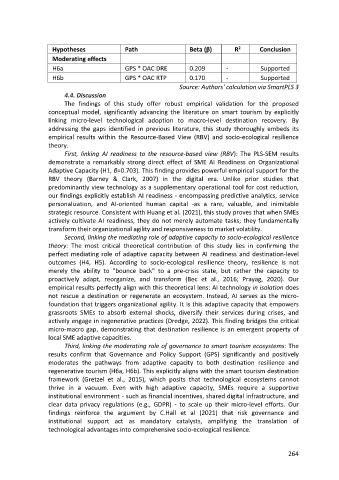
Hypotheses                Path                   Beta (β)       R 2      Conclusion
                   Moderating effects
                   H6a                       GPS * OAC DRE          0.209       -            Supported
                   H6b                       GPS * OAC RTP          0.170       -            Supported
                                                                Source: Authors' calculation via SmartPLS 3
                        4.4. Discussion
                        The findings of this study offer robust empirical validation for the proposed
                  conceptual model, significantly advancing the literature on smart tourism by explicitly
                  linking micro-level technological adoption to macro-level destination recovery. By
                  addressing the gaps identified in previous literature, this study thoroughly embeds its
                  empirical results within the Resource-Based View (RBV) and socio-ecological resilience
                  theory.
                        First, linking AI readiness to the resource-based view (RBV): The PLS-SEM results
                  demonstrate a remarkably strong direct effect of SME AI Readiness on Organizational
                  Adaptive Capacity (H1, β=0.703). This finding provides powerful empirical support for the
                  RBV theory (Barney & Clark, 2007) in the digital era. Unlike prior studies that
                  predominantly view technology as a supplementary operational tool for cost reduction,
                  our findings explicitly establish AI readiness - encompassing predictive analytics, service
                  personalization, and AI-oriented human capital -as a rare, valuable, and inimitable
                  strategic resource. Consistent with Huang et al. (2021), this study proves that when SMEs
                  actively cultivate AI readiness, they do not merely automate tasks; they fundamentally
                  transform their organizational agility and responsiveness to market volatility.
                        Second, linking the mediating role of adaptive capacity to socio-ecological resilience
                  theory: The most critical theoretical contribution of this study lies in confirming the
                  perfect mediating role of adaptive capacity between AI readiness and destination-level
                  outcomes (H4, H5). According to socio-ecological resilience theory, resilience is not
                  merely the ability to "bounce back" to a pre-crisis state, but rather the capacity to
                  proactively adapt, reorganize, and transform (Bec et al., 2016; Prayag, 2020). Our
                  empirical results perfectly align with this theoretical lens: AI technology in isolation does
                  not rescue a destination or regenerate an ecosystem. Instead, AI serves as the micro-
                  foundation that triggers organizational agility. It is this adaptive capacity that empowers
                  grassroots SMEs to absorb external shocks, diversify their services during crises, and
                  actively engage in regenerative practices (Dredge, 2022). This finding bridges the critical
                  micro-macro gap, demonstrating that destination resilience is an emergent property of
                  local SME adaptive capacities.
                        Third, linking the moderating role of governance to smart tourism ecosystems: The
                  results confirm that Governance and Policy Support (GPS) significantly and positively
                  moderates the pathways from adaptive capacity to both destination resilience and
                  regenerative tourism (H6a, H6b). This explicitly aligns with the smart tourism destination
                  framework (Gretzel et al., 2015), which posits that technological ecosystems cannot
                  thrive in a vacuum. Even with high adaptive capacity, SMEs require a supportive
                  institutional environment - such as financial incentives, shared digital infrastructure, and
                  clear data privacy regulations (e.g., GDPR) - to scale up their micro-level efforts. Our
                  findings reinforce the argument by C.Hall et al (2021) that risk governance and
                  institutional support act as mandatory catalysts, amplifying the translation of
                  technological advantages into comprehensive socio-ecological resilience.


                                                                                                      264

