


Page 262 - ISC PROCEEDINGS 21.4
P. 262
- "We can swiftly reallocate resources (financial and human) based on real-time AI
                  data."
                        Destination resilience (DRE): Measuring the perceived contribution of the firm to
                  the broader destination's recovery:
                        - "Our operational continuity significantly helps maintain local employment during
                  crises."
                        - "Our business practices contribute to the rapid recovery of visitor trust in the
                  destination."
                        Regenerative tourism practices (RTP): Measuring proactive ecological and social
                  restoration:
                        - "Our firm utilizes smart technologies to actively reduce carbon emissions and
                  minimize waste."
                        - "We actively engage in practices that restore and improve the local ecological
                  environment."
                        Governance and policy support (GPS): Measuring the moderating effect of the
                  institutional environment:
                        - "Local government provides sufficient digital infrastructure (e.g., high-speed
                  internet, data security laws) to support AI adoption."
                        - "There are adequate financial incentives or training programs from authorities for
                  tech-driven SMEs."
                        3.4. Data analysis method
                        The collected data will be analyzed using Partial Least Squares Structural Equation
                  Modeling (PLS-SEM) via SmartPLS software. PLS-SEM is particularly suitable for this study
                  because it excels at handling complex models that include multi-dimensional constructs,
                  mediating effects, and moderating variables, and it is highly effective for exploratory
                  research aimed at theory development. The analysis will proceed in two stages: first,
                  assessing the reliability and validity of the measurement model (outer model); and
                  second, testing the hypothesized paths and the significance of the mediating and
                  moderating effects within the structural model (inner model).
                        4. Results and discussion
                        4.1. Sample characteristics
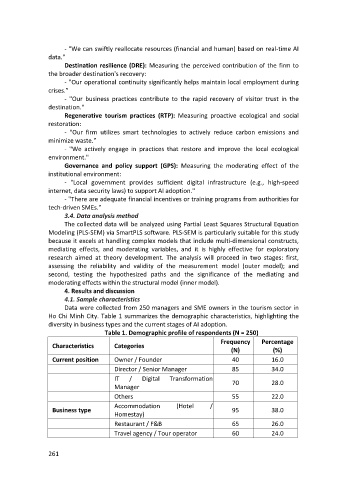
                        Data were collected from 250 managers and SME owners in the tourism sector in
                  Ho Chi Minh City. Table 1 summarizes the demographic characteristics, highlighting the
                  diversity in business types and the current stages of AI adoption.
                                      Table 1. Demographic profile of respondents (N = 250)
                                                                               Frequency     Percentage
                   Characteristics       Categories
                                                                                  (N)            (%)
                   Current position      Owner / Founder                           40           16.0
                                         Director / Senior Manager                 85           34.0
                                         IT   /    Digital   Transformation
                                         Manager                                   70           28.0
                                         Others                                    55           22.0
                                         Accommodation         (Hotel      /
                   Business type                                                   95           38.0
                                         Homestay)
                                         Restaurant / F&B                          65           26.0
                                         Travel agency / Tour operator             60           24.0


                  261

