


Page 263 - ISC PROCEEDINGS 21.4
P. 263
Frequency     Percentage
                   Characteristics       Categories
                                                                                  (N)            (%)
                                         Others                                    30           12.0
                   Number of             Under 10 employees                        80           32.0
                   employees
                                         10 - 50 employees                         70           28.0
                                         51 - 100 employees                        45           18.0
                                         Above 100 employees                       55           22.0
                   AI adoption level     Exploring / Testing phase                110           44.0
                                         Partially adopted                         85           34.0
                                         Fully integrated into operations          55           22.0
                                                                       Source: Authors' survey data (2026)
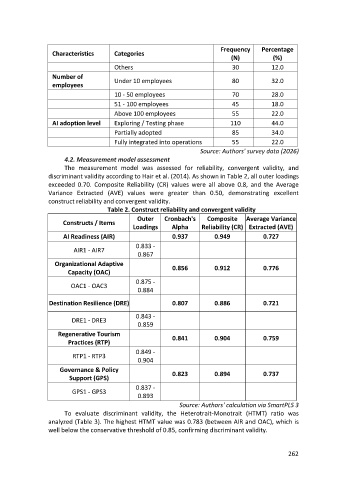
                        4.2. Measurement model assessment
                        The measurement model was assessed for reliability, convergent validity, and
                  discriminant validity according to Hair et al. (2014). As shown in Table 2, all outer loadings
                  exceeded 0.70. Composite Reliability (CR) values were all above 0.8, and the Average
                  Variance Extracted (AVE) values were greater than 0.50, demonstrating excellent
                  construct reliability and convergent validity.
                                       Table 2. Construct reliability and convergent validity
                                                 Outer     Cronbach's     Composite    Average Variance
                       Constructs / Items
                                                Loadings     Alpha      Reliability (CR) Extracted (AVE)
                       AI Readiness (AIR)                     0.937         0.949            0.727
                                                 0.833 -
                           AIR1 - AIR7
                                                 0.867
                    Organizational Adaptive                   0.856         0.912            0.776
                         Capacity (OAC)
                                                 0.875 -
                          OAC1 - OAC3
                                                 0.884
                  Destination Resilience (DRE)                0.807         0.886            0.721

                                                 0.843 -
                          DRE1 - DRE3
                                                 0.859
                     Regenerative Tourism                     0.841         0.904            0.759
                         Practices (RTP)
                                                 0.849 -
                          RTP1 - RTP3
                                                 0.904
                      Governance & Policy                     0.823         0.894            0.737
                         Support (GPS)
                                                 0.837 -
                          GPS1 - GPS3
                                                 0.893
                                                                Source: Authors' calculation via SmartPLS 3
                        To evaluate discriminant validity, the Heterotrait-Monotrait (HTMT) ratio was
                  analyzed (Table 3). The highest HTMT value was 0.783 (between AIR and OAC), which is
                  well below the conservative threshold of 0.85, confirming discriminant validity.


                                                                                                      262

