


Page 260 - ISC PROCEEDINGS 21.4
P. 260
2.5. The moderating role of governance and policy support
                        The successful translation of micro-level adaptive capacity into macro-level
                  destination resilience and regenerative tourism does not occur in a vacuum; it is
                  significantly contingent upon the broader institutional environment. Governance and
                  policy support encompass the regulatory frameworks, digital infrastructure investments,
                  financial incentives, and ethical guidelines established by public authorities to facilitate
                  technology adoption. In the context of AI, effective governance involves not only
                  promoting    innovation   through   capacity-building  programs    and   robust   digital
                  infrastructure but also ensuring data privacy - such as adherence to the General Data
                  Protection Regulation (GDPR) - and mitigating algorithmic biases.
                        This study posits that local governance and policy support act as critical moderating
                  variables. When tourism SMEs operate within a highly supportive policy environment, the
                  positive impact of their adaptive capacity on destination resilience and regenerative
                  practices is substantially amplified. Strategic public-private partnerships and government
                  interventions can help SMEs overcome high initial investment costs and technical barriers
                  associated with AI implementation. Conversely, inadequate policy support, lack of
                  regulatory clarity, or insufficient digital infrastructure can stifle SMEs' ability to fully
                  operationalize their AI capabilities, thereby weakening the pathway to sustainable
                  destination recovery.
                        2.6. Proposed research model and hypotheses
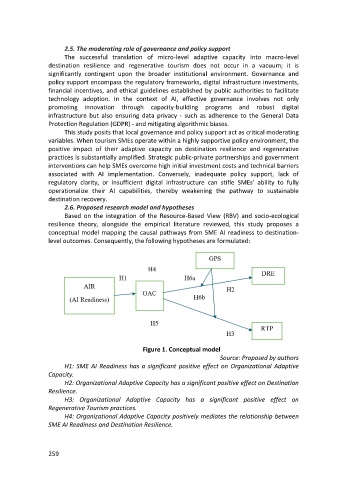
                        Based on the integration of the Resource-Based View (RBV) and socio-ecological
                  resilience theory, alongside the empirical literature reviewed, this study proposes a
                  conceptual model mapping the causal pathways from SME AI readiness to destination-
                  level outcomes. Consequently, the following hypotheses are formulated:


                                                   Figure 1. Conceptual model
                                                                              Source: Proposed by authors
                        H1: SME AI Readiness has a significant positive effect on Organizational Adaptive
                  Capacity.
                        H2: Organizational Adaptive Capacity has a significant positive effect on Destination
                  Resilience.
                        H3: Organizational Adaptive Capacity has a significant positive effect on
                  Regenerative Tourism practices.
                        H4: Organizational Adaptive Capacity positively mediates the relationship between
                  SME AI Readiness and Destination Resilience.


                  259

