


Page 202 - ISC PROCEEDINGS 21.4
P. 202
To ensure transparency in the operationalization of the framework, Table 4.1 maps
                  each layer to the corresponding international index and its key components.
                        Layer 1 – Digital government foundation: Vietnam has entered the “Very High
                  EGDI” group but still lags behind leading ASEAN countries
                        According to the UN E-Government Survey 2024, Vietnam achieved an EGDI score
                  of 0.7709, ranking 71st out of 193 countries and being classified for the first time in the
                  “Very High EGDI” category (United Nations, 2024). The index reflects the development of
                  the country’s e-government foundation through three core components: the Online
                  Service Index (OSI), the Telecommunication Infrastructure Index (TII), and the Human
                  Capital Index (HCI).
                        Within this structure, Vietnam records OSI = 0.7081, HCI = 0.7267, and TII = 0.8780,
                  suggesting that digital connectivity infrastructure is currently the strongest component of
                  the country’s digital government system. The E-Participation Index (0.6027) indicates that
                  citizens’ digital engagement in governance has improved in recent years, although it
                  remains below the level observed in leading countries.
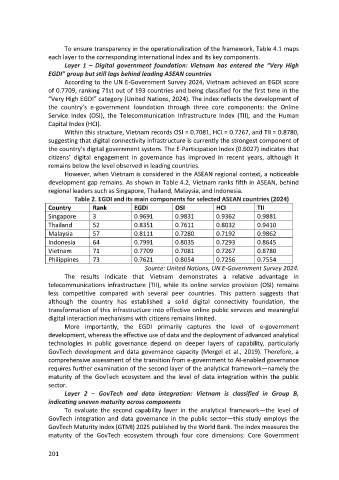
                        However, when Vietnam is considered in the ASEAN regional context, a noticeable
                  development gap remains. As shown in Table 4.2, Vietnam ranks fifth in ASEAN, behind
                  regional leaders such as Singapore, Thailand, Malaysia, and Indonesia.
                           Table 2. EGDI and its main components for selected ASEAN countries (2024)
                  Country         Rank          EGDI           OSI           HCI           TII
                  Singapore       3             0.9691         0.9831        0.9362        0.9881
                  Thailand        52            0.8351         0.7611        0.8032        0.9410
                  Malaysia        57            0.8111         0.7280        0.7192        0.9862
                  Indonesia       64            0.7991         0.8035        0.7293        0.8645
                  Vietnam         71            0.7709         0.7081        0.7267        0.8780
                  Philippines     73            0.7621         0.8054        0.7256        0.7554
                                                    Source: United Nations, UN E-Government Survey 2024.
                        The results indicate that Vietnam demonstrates a relative advantage in
                  telecommunications infrastructure (TII), while its online service provision (OSI) remains
                  less competitive compared with several peer countries. This pattern suggests that
                  although the country has established a solid digital connectivity foundation, the
                  transformation of this infrastructure into effective online public services and meaningful
                  digital interaction mechanisms with citizens remains limited.
                        More importantly, the EGDI primarily captures the level of e-government
                  development, whereas the effective use of data and the deployment of advanced analytical
                  technologies in public governance depend on deeper layers of capability, particularly
                  GovTech development and data governance capacity (Mergel et al., 2019). Therefore, a
                  comprehensive assessment of the transition from e-government to AI-enabled governance
                  requires further examination of the second layer of the analytical framework—namely the
                  maturity of the GovTech ecosystem and the level of data integration within the public
                  sector.
                        Layer 2 – GovTech and data integration: Vietnam is classified in Group B,
                  indicating uneven maturity across components
                        To evaluate the second capability layer in the analytical framework—the level of
                  GovTech integration and data governance in the public sector—this study employs the
                  GovTech Maturity Index (GTMI) 2025 published by the World Bank. The index measures the
                  maturity of the GovTech ecosystem through four core dimensions: Core Government


                  201

