


Page 204 - ISC PROCEEDINGS 21.4
P. 204
Readiness Index 2025 published by Oxford Insights. Compared with earlier editions, the
                  2025 report assesses government AI readiness through six pillars: Policy Capacity, AI
                  Infrastructure, Governance, Public Sector Adoption, Development and Diffusion, and
                  Resilience. Together, these dimensions capture key aspects of AI preparedness, including
                  policy capability, technological infrastructure, innovation ecosystems, and the practical
                  adoption of AI within government institutions.
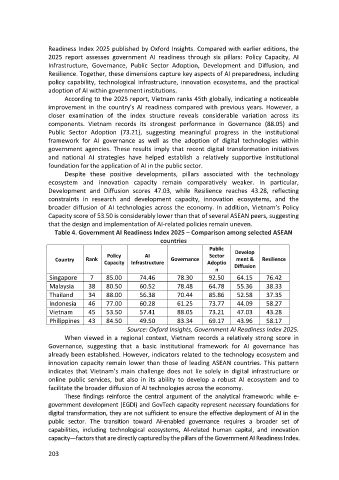
                        According to the 2025 report, Vietnam ranks 45th globally, indicating a noticeable
                  improvement in the country’s AI readiness compared with previous years. However, a
                  closer examination of the index structure reveals considerable variation across its
                  components. Vietnam records its strongest performance in Governance (88.05) and
                  Public Sector Adoption (73.21), suggesting meaningful progress in the institutional
                  framework for AI governance as well as the adoption of digital technologies within
                  government agencies. These results imply that recent digital transformation initiatives
                  and national AI strategies have helped establish a relatively supportive institutional
                  foundation for the application of AI in the public sector.
                        Despite these positive developments, pillars associated with the technology
                  ecosystem and innovation capacity remain comparatively weaker. In particular,
                  Development and Diffusion scores 47.03, while Resilience reaches 43.28, reflecting
                  constraints in research and development capacity, innovation ecosystems, and the
                  broader diffusion of AI technologies across the economy. In addition, Vietnam’s Policy
                  Capacity score of 53.50 is considerably lower than that of several ASEAN peers, suggesting
                  that the design and implementation of AI-related policies remain uneven.
                    Table 4. Government AI Readiness Index 2025 – Comparison among selected ASEAN
                                                         countries
                                                                           Public
                                       Policy       AI                     Sector   Develop
                    Country    Rank                          Governance             ment &   Resilience
                                      Capacity  Infrastructure            Adoptio  Diffusion
                                                                             n
                  Singapore      7    85.00       74.46        78.30      92.50     64.15      76.42
                  Malaysia      38    80.50       60.52        78.48      64.78     55.36      38.33
                  Thailand      34    88.00       56.38        70.44      85.86     52.58      37.35
                  Indonesia     46    77.00       60.28        61.25      73.77     44.09      58.27
                  Vietnam       45    53.50       57.41        88.05      73.21     47.03      43.28
                  Philippines   43    84.50       49.50        83.34      69.17     43.96      58.17
                                              Source: Oxford Insights, Government AI Readiness Index 2025.
                        When viewed in a regional context, Vietnam records a relatively strong score in
                  Governance, suggesting that a basic institutional framework for AI governance has
                  already been established. However, indicators related to the technology ecosystem and
                  innovation capacity remain lower than those of leading ASEAN countries. This pattern
                  indicates that Vietnam’s main challenge does not lie solely in digital infrastructure or
                  online public services, but also in its ability to develop a robust AI ecosystem and to
                  facilitate the broader diffusion of AI technologies across the economy.
                        These findings reinforce the central argument of the analytical framework: while e-
                  government development (EGDI) and GovTech capacity represent necessary foundations for
                  digital transformation, they are not sufficient to ensure the effective deployment of AI in the
                  public sector. The transition toward AI-enabled governance requires a broader set of
                  capabilities, including technological ecosystems, AI-related human capital, and innovation
                  capacity—factors that are directly captured by the pillars of the Government AI Readiness Index.

                  203

