


Page 169 - ISC PROCEEDINGS 21.4
P. 169
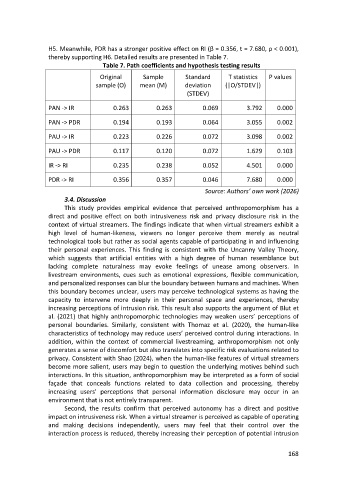
H5. Meanwhile, PDR has a stronger positive effect on RI (β = 0.356, t = 7.680, p < 0.001),
                  thereby supporting H6. Detailed results are presented in Table 7.
                                     Table 7. Path coefficients and hypothesis testing results

                                    Original       Sample         Standard       T statistics  P values
                                   sample (O)     mean (M)        deviation     (|O/STDEV|)
                                                                   (STDEV)


                  PAN -> IR              0.263          0.263           0.069           3.792     0.000

                  PAN -> PDR             0.194          0.193           0.064           3.055     0.002

                  PAU -> IR              0.223          0.226           0.072           3.098     0.002

                  PAU -> PDR             0.117          0.120           0.072           1.629     0.103

                  IR -> RI               0.235          0.238           0.052           4.501     0.000

                  PDR -> RI              0.356          0.357           0.046           7.680     0.000

                                                                         Source: Authors’ own work (2026)
                        3.4. Discussion
                        This study provides empirical evidence that perceived anthropomorphism has a
                  direct and positive effect on both intrusiveness risk and privacy disclosure risk in the
                  context of virtual streamers. The findings indicate that when virtual streamers exhibit a
                  high level of human-likeness, viewers no longer perceive them merely as neutral
                  technological tools but rather as social agents capable of participating in and influencing
                  their personal experiences. This finding is consistent with the Uncanny Valley Theory,
                  which suggests that artificial entities with a high degree of human resemblance but
                  lacking complete naturalness may evoke feelings of unease among observers. In
                  livestream environments, cues such as emotional expressions, flexible communication,
                  and personalized responses can blur the boundary between humans and machines. When
                  this boundary becomes unclear, users may perceive technological systems as having the
                  capacity to intervene more deeply in their personal space and experiences, thereby
                  increasing perceptions of intrusion risk. This result also supports the argument of Blut et
                  al. (2021) that highly anthropomorphic technologies may weaken users’ perceptions of
                  personal boundaries. Similarly, consistent with Thomaz et al. (2020), the human-like
                  characteristics of technology may reduce users’ perceived control during interactions. In
                  addition, within the context of commercial livestreaming, anthropomorphism not only
                  generates a sense of discomfort but also translates into specific risk evaluations related to
                  privacy. Consistent with Shao (2024), when the human-like features of virtual streamers
                  become more salient, users may begin to question the underlying motives behind such
                  interactions. In this situation, anthropomorphism may be interpreted as a form of social
                  façade that conceals functions related to data collection and processing, thereby
                  increasing users’ perceptions that personal information disclosure may occur in an
                  environment that is not entirely transparent.
                        Second, the results confirm that perceived autonomy has a direct and positive
                  impact on intrusiveness risk. When a virtual streamer is perceived as capable of operating
                  and making decisions independently, users may feel that their control over the
                  interaction process is reduced, thereby increasing their perception of potential intrusion


                                                                                                      168

