


Page 165 - ISC PROCEEDINGS 21.4
P. 165
et al., 2022). Furthermore, in sensitive sectors like finance, data collection evokes a "being
                  watched" sensation, prompting users to maintain the status quo rather than adopting
                  robo-advisors (Aw et al., 2024). Most recently, regarding virtual streamers, when
                  consumers perceive algorithmic surveillance as a threat to their boundaries, they actively
                  manifest resistance by withdrawing to regain control (Shao & Ho, 2025). Thus, the
                  following hypothesis is proposed:
                        H6: Intrusiveness risk has a positive effect on resistance intention.
                        2.3. Proposed research model
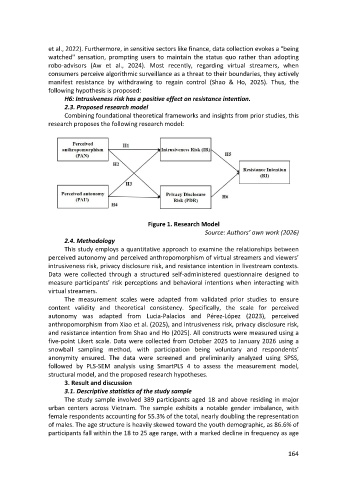
                        Combining foundational theoretical frameworks and insights from prior studies, this
                  research proposes the following research model:


                                                     Figure 1. Research Model
                                                                         Source: Authors’ own work (2026)
                        2.4. Methodology
                        This study employs a quantitative approach to examine the relationships between
                  perceived autonomy and perceived anthropomorphism of virtual streamers and viewers’
                  intrusiveness risk, privacy disclosure risk, and resistance intention in livestream contexts.
                  Data were collected through a structured self-administered questionnaire designed to
                  measure participants’ risk perceptions and behavioral intentions when interacting with
                  virtual streamers.
                        The measurement scales were adapted from validated prior studies to ensure
                  content validity and theoretical consistency. Specifically, the scale for perceived
                  autonomy was adapted from Lucia-Palacios and Pérez-López (2023), perceived
                  anthropomorphism from Xiao et al. (2025), and intrusiveness risk, privacy disclosure risk,
                  and resistance intention from Shao and Ho (2025). All constructs were measured using a
                  five-point Likert scale. Data were collected from October 2025 to January 2026 using a
                  snowball sampling method, with participation being voluntary and respondents’
                  anonymity ensured. The data were screened and preliminarily analyzed using SPSS,
                  followed by PLS-SEM analysis using SmartPLS 4 to assess the measurement model,
                  structural model, and the proposed research hypotheses.
                        3. Result and discussion
                        3.1. Descriptive statistics of the study sample
                        The study sample involved 389 participants aged 18 and above residing in major
                  urban centers across Vietnam. The sample exhibits a notable gender imbalance, with
                  female respondents accounting for 55.3% of the total, nearly doubling the representation
                  of males. The age structure is heavily skewed toward the youth demographic, as 86.6% of
                  participants fall within the 18 to 25 age range, with a marked decline in frequency as age


                                                                                                      164

