


Page 745 - ISC PROCEEDINGS 21.4
P. 745
Literature
                  Category         Key Themes            Key Authors      Strengths      Limitations
                                   Web3.0 privacy risks;                                 Views humans
                  Data    Security,  social     network  Chen    et   al. Valuable       as     passive
                  Decentralisation  security     models;  (2022). Shyian foresight into  nodes,     not
                  &       Human-                         (2021); Goodell socio-
                  Centric Trust    consensual     digital  (2021)         technical risks  active learning
                                   trust                                                 agents
                                             Source: Compiled by the authors based on reviewed literature.
                        Note: DESI = Digital Economy and Society Index. Strength and limitation assessments
                  reflect the authors' analytical interpretation of each literature stream's contribution to the
                  research problem.
                        While these literature streams provide a comprehensive understanding of digital
                  transformation, they collectively reveal critical gaps: a lack of micro-level strategies for
                  businesses to adapt to changing labour dynamics, insufficient attention to individual
                  learning mechanisms within policy and governance frameworks, and a tendency to view
                  human users as passive nodes rather than active agents requiring targeted educational
                  support within decentralised trust systems. These limitations underscore the need for an
                  integrated framework that bridges disciplinary divides to cultivate human capital
                  proactively.
                        2.2. Theoretical framework
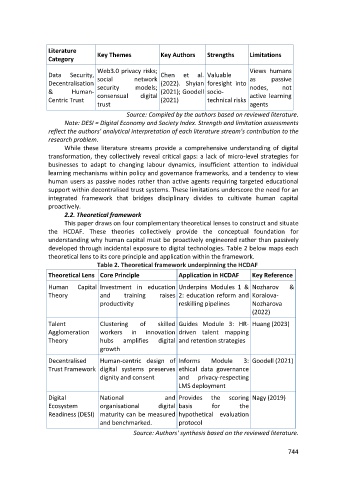
                        This paper draws on four complementary theoretical lenses to construct and situate
                  the HCDAF. These theories collectively provide the conceptual foundation for
                  understanding why human capital must be proactively engineered rather than passively
                  developed through incidental exposure to digital technologies. Table 2 below maps each
                  theoretical lens to its core principle and application within the framework.
                                   Table 2. Theoretical framework underpinning the HCDAF
                  Theoretical Lens Core Principle               Application in HCDAF      Key Reference

                  Human     Capital Investment in education Underpins Modules 1 & Nozharov             &
                  Theory            and      training    raises 2: education reform and Koralova-
                                    productivity                reskilling pipelines      Nozharova
                                                                                          (2022)

                  Talent            Clustering    of    skilled Guides Module 3: HR- Huang (2023)
                  Agglomeration     workers    in   innovation driven talent mapping
                  Theory            hubs    amplifies    digital and retention strategies
                                    growth

                  Decentralised     Human-centric design of Informs        Module      3: Goodell (2021)
                  Trust Framework digital systems preserves ethical data governance
                                    dignity and consent         and    privacy-respecting
                                                                LMS deployment
                  Digital           National               and Provides    the   scoring Nagy (2019)
                  Ecosystem         organisational       digital basis     for       the
                  Readiness (DESI) maturity can be measured hypothetical evaluation
                                    and benchmarked.            protocol
                                                Source: Authors' synthesis based on the reviewed literature.


                                                                                                      744

