


Page 750 - ISC PROCEEDINGS 21.4
P. 750
constitutes a methodological result of the study- a replicable blueprint for future
                  empirical validation.
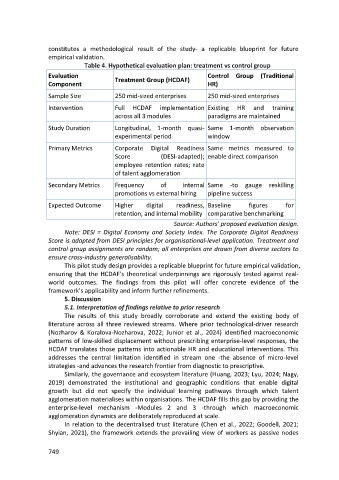
                               Table 4. Hypothetical evaluation plan: treatment vs control group

                  Evaluation             Treatment Group (HCDAF)          Control   Group    (Traditional
                  Component                                               HR)

                  Sample Size            250 mid-sized enterprises        250 mid-sized enterprises
                  Intervention           Full   HCDAF    implementation Existing    HR    and    training
                                         across all 3 modules             paradigms are maintained

                  Study Duration         Longitudinal, 1-month quasi- Same 1-month observation
                                         experimental period              window
                  Primary Metrics        Corporate    Digital  Readiness Same metrics measured to
                                         Score            (DESI-adapted); enable direct comparison
                                         employee retention rates; rate
                                         of talent agglomeration

                  Secondary Metrics      Frequency       of      internal Same    -to  gauge    reskilling
                                         promotions vs external hiring    pipeline success

                  Expected Outcome       Higher     digital    readiness, Baseline      figures      for
                                         retention, and internal mobility comparative benchmarking
                                                              Source: Authors' proposed evaluation design.
                        Note: DESI = Digital Economy and Society Index. The Corporate Digital Readiness
                  Score is adapted from DESI principles for organisational-level application. Treatment and
                  control group assignments are random; all enterprises are drawn from diverse sectors to
                  ensure cross-industry generalisability.
                        This pilot study design provides a replicable blueprint for future empirical validation,
                  ensuring that the HCDAF’s theoretical underpinnings are rigorously tested against real-
                  world outcomes. The findings from this pilot will offer concrete evidence of the
                  framework’s applicability and inform further refinements.
                        5. Discussion
                        5.1. Interpretation of findings relative to prior research
                        The results of this study broadly corroborate and extend the existing body of
                  literature across all three reviewed streams. Where prior technological-driver research
                  (Nozharov & Koralova-Nozharova, 2022; Junior et al., 2024) identified macroeconomic
                  patterns of low-skilled displacement without prescribing enterprise-level responses, the
                  HCDAF translates those patterns into actionable HR and educational interventions. This
                  addresses the central limitation identified in stream one -the absence of micro-level
                  strategies -and advances the research frontier from diagnostic to prescriptive.
                        Similarly, the governance and ecosystem literature (Huang, 2023; Lyu, 2024; Nagy,
                  2019) demonstrated the institutional and geographic conditions that enable digital
                  growth but did not specify the individual learning pathways through which talent
                  agglomeration materialises within organisations. The HCDAF fills this gap by providing the
                  enterprise-level mechanism -Modules 2 and 3 -through which macroeconomic
                  agglomeration dynamics are deliberately reproduced at scale.
                        In relation to the decentralised trust literature (Chen et al., 2022; Goodell, 2021;
                  Shyian, 2021), the framework extends the prevailing view of workers as passive nodes


                  749

