


Page 747 - ISC PROCEEDINGS 21.4
P. 747
Semi-structured Interviews: Qualitative interviews with HR directors and training
                  managers in a sample of treatment-group enterprises to capture implementation
                  challenges and contextual factors.
                        Document Analysis: Review of enterprise training curricula, learning management
                  system logs, and policy documentation to assess fidelity of HCDAF implementation.
                        This multi-instrument approach ensures methodological triangulation, enhancing
                  both the validity and the transferability of eventual findings across diverse enterprise
                  contexts.
                        3. The human capital digital adaptability framework (HCDAF)
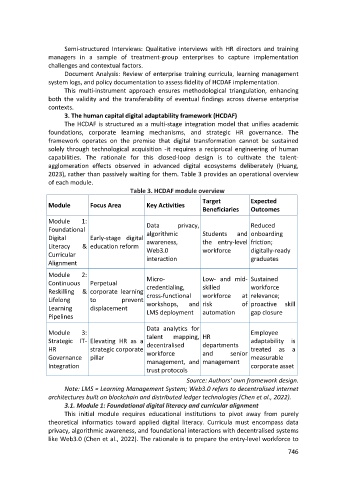
                        The HCDAF is structured as a multi-stage integration model that unifies academic
                  foundations, corporate learning mechanisms, and strategic HR governance. The
                  framework operates on the premise that digital transformation cannot be sustained
                  solely through technological acquisition -it requires a reciprocal engineering of human
                  capabilities. The rationale for this closed-loop design is to cultivate the talent-
                  agglomeration effects observed in advanced digital ecosystems deliberately (Huang,
                  2023), rather than passively waiting for them. Table 3 provides an operational overview
                  of each module.
                                               Table 3. HCDAF module overview
                                                                        Target           Expected
                  Module         Focus Area          Key Activities
                                                                        Beneficiaries    Outcomes
                  Module      1:
                                                                                         Reduced
                  Foundational                       Data      privacy,  Students   and onboarding
                                                     algorithmic
                  Digital        Early-stage digital  awareness,        the entry-level friction;
                  Literacy    & education reform
                  Curricular                         Web3.0             workforce        digitally-ready
                                                     interaction
                                                                                         graduates
                  Alignment
                  Module      2:
                  Continuous     Perpetual           Micro-             Low- and mid- Sustained
                                                                        skilled
                                                                                         workforce
                                                     credentialing,
                  Reskilling  & corporate learning   cross-functional   workforce     at relevance;
                  Lifelong       to         prevent
                  Learning       displacement        workshops,    and risk           of proactive   skill
                                                     LMS deployment
                                                                        automation
                                                                                         gap closure
                  Pipelines
                                                     Data analytics for
                  Module      3:                     talent   mapping, HR                Employee
                  Strategic  IT- Elevating HR as a                                       adaptability  is
                  HR             strategic corporate  decentralised     departments      treated   as   a
                                                     workforce
                                                                        and
                                                                                  senior
                  Governance     pillar              management, and management          measurable
                  Integration                                                            corporate asset
                                                     trust protocols
                                                                   Source: Authors' own framework design.
                        Note: LMS = Learning Management System; Web3.0 refers to decentralised internet
                  architectures built on blockchain and distributed ledger technologies (Chen et al., 2022).
                        3.1. Module 1: Foundational digital literacy and curricular alignment
                        This initial module requires educational institutions to pivot away from purely
                  theoretical informatics toward applied digital literacy. Curricula must encompass data
                  privacy, algorithmic awareness, and foundational interactions with decentralised systems
                  like Web3.0 (Chen et al., 2022). The rationale is to prepare the entry-level workforce to

                                                                                                      746

