


Page 744 - ISC PROCEEDINGS 21.4
P. 744
demands generated by rapid digital transformation. Three systemic failures underpin this
                  insufficiency. First, contemporary corporate strategies overwhelmingly prioritise capital
                  expenditure on hardware and software, severely under-investing in the psychosocial and
                  technical adaptability of their human workforce. Second, a profound structural
                  disconnect persists between traditional academic curricula and the highly dynamic
                  competency requirements of modern digital enterprises, leaving new graduates
                  fundamentally unprepared for complex digital environments. Third, legacy human
                  resource paradigms continue to treat talent management as a static administrative
                  function rather than an integrated strategic asset that leverages data analytics and digital
                  ecosystems to foster innovation.
                        1.3. Main issues the paper addresses
                        This paper addresses three key research issues: how educational institutions and
                  corporations can align foundational digital literacy programmes with the evolving
                  demands of the digital economy; what organisational mechanisms and HR governance
                  structures are needed to sustain continuous workforce reskilling and prevent
                  technological displacement; and how strategic HR functions can leverage data analytics
                  and decentralised digital tools to cultivate talent agglomeration and protect employee
                  dignity.
                        To address these questions, this paper introduces the Human Capital Digital
                  Adaptability Framework (HCDAF), a structured, tripartite methodology that integrates
                  early-stage digital literacy education, continuous corporate reskilling pipelines, and
                  strategic IT-HR governance. The paper also presents a hypothetical evaluation protocol to
                  assess the framework's impact and delineates the ethical risks of rapid digitalisation, with
                  actionable mitigation strategies.
                        2. Literature review, theoretical framework, and research methodology
                        2.1. Literature review
                        To adequately contextualise the mechanisms through which human capital must
                  evolve, it is necessary to examine the existing literature surrounding digital
                  transformation. The prevailing research can be systematically organised into three
                  distinct subtopics: (i) technological drivers and labour dynamics, (ii) policy, governance,
                  and ecosystem agglomeration, and (iii) data security, decentralisation, and human-centric
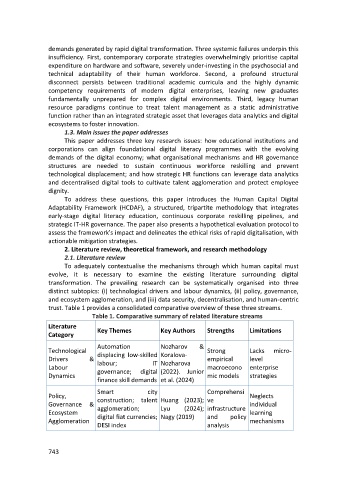
                  trust. Table 1 provides a consolidated comparative overview of these three streams.
                                 Table 1. Comparative summary of related literature streams
                  Literature       Key Themes            Key Authors      Strengths      Limitations
                  Category

                                   Automation            Nozharov      &
                  Technological                                           Strong         Lacks   micro-
                  Drivers       &  displacing low-skilled Koralova-       empirical      level
                                                       IT Nozharova
                                   labour;
                  Labour           governance;    digital (2022). Junior  macroecono     enterprise
                  Dynamics                                                mic models     strategies
                                   finance skill demands et al. (2024)
                                   Smart             city                 Comprehensi
                  Policy,          construction;   talent Huang (2023); ve               Neglects
                  Governance    &                                                        individual
                  Ecosystem        agglomeration;        Lyu      (2024); infrastructure  learning
                                                                          and
                                                                                  policy
                                   digital fiat currencies; Nagy (2019)
                  Agglomeration                                                          mechanisms
                                   DESI index                             analysis


                  743

