


Page 614 - ISC PROCEEDINGS 21.4
P. 614
4.2. Hierarchical structure of research output
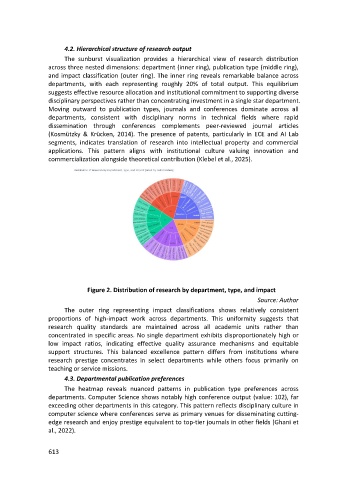
                        The sunburst visualization provides a hierarchical view of research distribution
                  across three nested dimensions: department (inner ring), publication type (middle ring),
                  and impact classification (outer ring). The inner ring reveals remarkable balance across
                  departments, with each representing roughly 20% of total output. This equilibrium
                  suggests effective resource allocation and institutional commitment to supporting diverse
                  disciplinary perspectives rather than concentrating investment in a single star department.
                  Moving outward to publication types, journals and conferences dominate across all
                  departments, consistent with disciplinary norms in technical fields where rapid
                  dissemination through conferences complements peer-reviewed journal articles
                  (Kosmützky & Krücken, 2014). The presence of patents, particularly in ECE and AI Lab
                  segments, indicates translation of research into intellectual property and commercial
                  applications. This pattern aligns with institutional culture valuing innovation and
                  commercialization alongside theoretical contribution (Klebel et al., 2025).


                                Figure 2. Distribution of research by department, type, and impact

                                                                                           Source: Author
                        The outer ring representing impact classifications shows relatively consistent
                  proportions of high-impact work across departments. This uniformity suggests that
                  research quality standards are maintained across all academic units rather than
                  concentrated in specific areas. No single department exhibits disproportionately high or
                  low impact ratios, indicating effective quality assurance mechanisms and equitable
                  support structures. This balanced excellence pattern differs from institutions where
                  research prestige concentrates in select departments while others focus primarily on
                  teaching or service missions.
                        4.3. Departmental publication preferences
                        The heatmap reveals nuanced patterns in publication type preferences across
                  departments. Computer Science shows notably high conference output (value: 102), far
                  exceeding other departments in this category. This pattern reflects disciplinary culture in
                  computer science where conferences serve as primary venues for disseminating cutting-
                  edge research and enjoy prestige equivalent to top-tier journals in other fields (Ghani et
                  al., 2022).


                  613

