


Page 613 - ISC PROCEEDINGS 21.4
P. 613
(single-department vs. interdisciplinary), and network centrality metrics. Funding success
                  was structured as a categorical target variable based on the funding amount allocated to
                  each project. To model collaboration as a predictor of funding success, correlation
                  matrices and predictive visualization modeling were employed. This approach allowed for
                  the identification of statistical relationships between the complexity of a research team's
                  interdisciplinary network and their corresponding funding impact classification, thereby
                  establishing a data-driven link between collaborative practices and resource acquisition.
                        4. Results and discussions
                        This section presents findings across eight analytical dimensions, integrating
                  quantitative results with interpretive discussion. Each subsection corresponds to a
                  specific visualization technique and addresses distinct aspects of the university research
                  ecosystem.

                        4.1. Research themes and keyword patterns


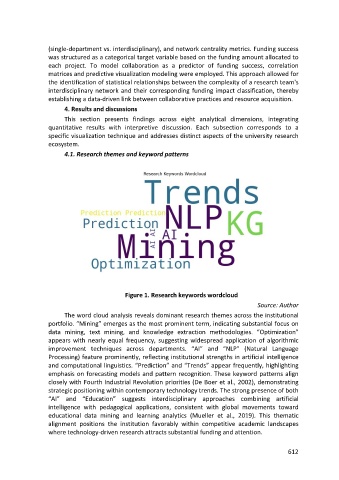
                                             Figure 1. Research keywords wordcloud
                                                                                           Source: Author
                        The word cloud analysis reveals dominant research themes across the institutional
                  portfolio. “Mining” emerges as the most prominent term, indicating substantial focus on
                  data mining, text mining, and knowledge extraction methodologies. “Optimization”
                  appears with nearly equal frequency, suggesting widespread application of algorithmic
                  improvement techniques across departments. “AI” and “NLP” (Natural Language
                  Processing) feature prominently, reflecting institutional strengths in artificial intelligence
                  and computational linguistics. “Prediction” and “Trends” appear frequently, highlighting
                  emphasis on forecasting models and pattern recognition. These keyword patterns align
                  closely with Fourth Industrial Revolution priorities (De Boer et al., 2002), demonstrating
                  strategic positioning within contemporary technology trends. The strong presence of both
                  “AI” and “Education” suggests interdisciplinary approaches combining artificial
                  intelligence with pedagogical applications, consistent with global movements toward
                  educational data mining and learning analytics (Mueller et al., 2019). This thematic
                  alignment positions the institution favorably within competitive academic landscapes
                  where technology-driven research attracts substantial funding and attention.


                                                                                                      612

